Ctrl K
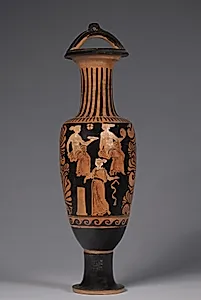
**The CA Painter** was a leading figure in ancient Campanian red-figure vase painting, active in the Greek colonies of South Italy during the Late Classical period. Working primarily in the coastal city of Cumae rather than the more central hub of Capua, he founded and dominated a major workshop after around 350 BC. As the namesake of the large CA Group (standing for “Cumaean”), he is widely regarded as the most accomplished artist of Campanian vase painting overall. His output reflects the distinctive local environment, frequently depicting Oscan warriors—the indigenous inhabitants of Campania—alongside mythological and everyday scenes.
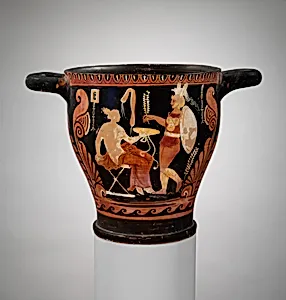
Stylistically, the CA Painter worked in the red-figure technique on the region’s characteristic light clay, which fired to a pinkish tone. He employed a polychrome approach, making extensive use of added white for female figures, architecture, and decorative elements, creating a striking visual contrast. Common motifs included naiskos (shrine) and grave scenes, Dionysiac revels, symposia, and bejewelled female heads. From about 330 BC onward, his work shows increasing Apulian influence in composition and ornament. A fine example of his style is a terracotta skyphos (deep drinking cup) in the Metropolitan Museum of Art, dated circa 350–325 BCE, which depicts a woman and an Oscan warrior on one side and a woman with a youth on the other.
Little is known of the painter’s personal life or training, as is typical for ancient artisans identified primarily through stylistic analysis of surviving vases. His workshop produced a large body of work, and he collaborated with followers who continued the tradition. His immediate successors, the CB Painter and CC Painter, maintained some of his technical traits but could not sustain the same level of quality or innovation.
The CA Painter’s legacy lies in elevating Campanian vase painting to its highest point before its decline around 300 BC. His emphasis on local subjects, combined with refined polychromy and narrative skill, helped define the regional style and influenced later South Italian production. Today, his attributed vases, including the single example in this collection, offer valuable insight into the cultural fusion of Greek artistic traditions with the indigenous communities of ancient Campania.