
Ctrl K
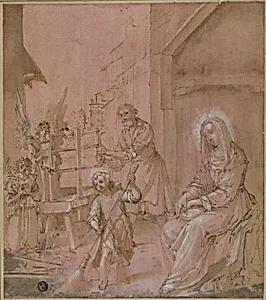
1551–1640
**Jacopo da Empoli (also known as Jacopo Chimenti), 1551–1640, was a leading Florentine painter of the Counter-Mannerist reform movement.** Born Jacopo Chimenti in Florence on 30 April 1551, he took his professional name from Empoli, the town of his father’s birth. He worked almost exclusively in his native city and became known for clear, balanced compositions that rejected the exaggerated distortions of late Mannerism in favor of greater naturalism and devotional clarity aligned with Counter-Reformation ideals.
He trained under the respected Florentine painter Maso da San Friano and absorbed an earlier, more restrained tradition that looked back toward Andrea del Sarto. His style is often grouped with that of his contemporary Santi di Tito; both artists favored crisp forms, legible narratives, and less crowded arrangements than their Mannerist predecessors such as Giorgio Vasari. Jacopo collaborated on occasion with Alessandro Tiarini and, after the 1620s, produced a small but remarkable group of still-life paintings—unusual for Florentine artists of the period—that rank among his most original contributions.
Among his documented works are the *Madonna in Glory with Saint Luke and Saint Ives* (1579, Louvre), *Sacrifice of Isaac* (1590s, Uffizi), *Susanna and the Elders* (1600, Kunsthistorisches Museum, Vienna), and several large altarpieces, including *Sant’Eligio* (1614, Uffizi) and *Carlo Borromeo and the Rospigliosi Family* (1613, San Domenico, Pistoia). He also painted historical subjects such as *Michelangelo Presents His Model of San Lorenzo to Leo X* (1617–19, Casa Buonarroti). His younger brother Domenico Chimenti was likewise a painter, and Jacopo himself trained a number of pupils, among them Felice Ficherelli, Giovanni Battista Vanni, and Virgilio Zaballi.
Jacopo da Empoli died in Florence on 30 September 1640 at the age of eighty-nine. Works attributed to the “circle of” Jacopo Chimenti, called Jacopo da Empoli, reflect the enduring influence of his clear, reformist manner on later Florentine painters. His legacy lies in the measured, figure-centered style he helped establish and in the many artists he trained who carried that approach into the seventeenth century.