Ctrl K
Calvin W. Burnett (1921–2007) was a pioneering African-American artist, illustrator, and educator whose eclectic practice bridged commercial art, fine printmaking, and social commentary. Born on July 18, 1921, in Cambridge, Massachusetts, into a family of four children facing the hardships of the Great Depression—his father was a physician often paid in goods like chickens or beans—Burnett discovered his talent early by copying comic strips. A reluctant student otherwise, he excelled at Cambridge High and Latin School before entering the Massachusetts School of Art (now Massachusetts College of Art and Design), from which he graduated with a B.F.A. and B.S. in education in 1942.) Exempt from World War II service due to poor eyesight, he worked in a shipyard before pursuing an M.F.A. from Boston University in 1960, where he was also a doctoral candidate.
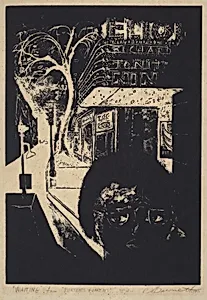
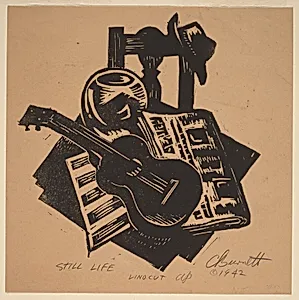
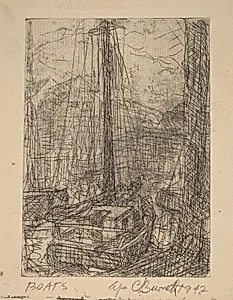
Burnett's career spanned freelancing in commercial art and decades of teaching across New England institutions, including over 33 years at Massachusetts College of Art, the DeCordova Museum, MIT, and the Elma Lewis School in Boston's segregated Roxbury neighborhood. His teaching philosophy emphasized mastering rules to break them innovatively, inspiring generations of illustrators—he even brought in peers like Ed Emberley for student presentations. Stylistically versatile, Burnett worked across media—oils, linocuts, woodcuts, collages, and photographic elements—favoring angular, swooping lines in stark black, white, and gray tones that conveyed introversion, sorrow, and resilient determination, evoking the blues of Billie Holiday and Bessie Smith. His themes often grappled with racial identity and civil rights, reflecting his era's struggles.
Among his notable works are the 1942 linocut *Tavern* (Metropolitan Museum of Art), the 1952 *Other Woman Blues* (Pennsylvania Academy of the Fine Arts), and *Waiting* (1955, National Gallery of Art). Later prints like *Sojourner Truth: I’ll Keep You Scratchin’* (1964 color lithograph) and *Freedom Fighter for Operation Exodus* (1969 lithograph, inspired by Boston's school desegregation efforts) exemplify his activist edge, as does the monumental 1994 *Figure with Collage*. Burnett exhibited widely at venues including the Smithsonian Institution and Brooklyn Museum.
Burnett's legacy endures as a mentor who humanized the illustrator's profession while advancing Black voices in American art. After three decades in Medway, Massachusetts, he passed on October 8, 2007, from Alzheimer's complications, leaving a profound impact on art education and mid-century printmaking.)