Ctrl K
1758–1836
**Carle Vernet** (Antoine Charles Horace Vernet, 1758–1836) was a prominent French painter renowned for his dynamic depictions of horses, hunting scenes, and Napoleonic battle subjects. Born in Bordeaux as the youngest child of the celebrated marine and landscape painter Claude-Joseph Vernet, he displayed an early and intense passion for drawing horses from the age of five. He received a conventional academic training as a pupil of his father and of Nicolas-Bernard Lépicié, winning the prestigious Prix de Rome in 1782. However, after arriving in Rome, he lost interest in his studies; his father recalled him to prevent him from entering a monastery.
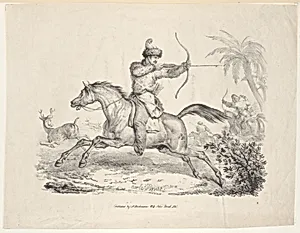
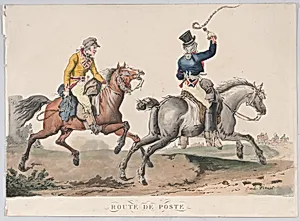
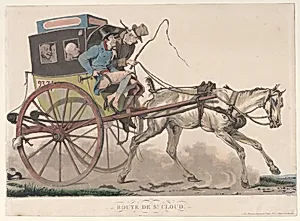
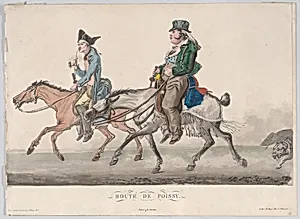
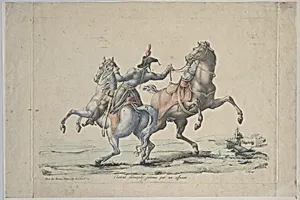
Vernet initially worked in the academic tradition but broke with convention in works such as *The Triumph of Aemilius Paulus* by rendering horses with naturalistic forms observed directly from stables and riding schools rather than idealized models. His career took a dramatic turn during the French Revolution when his sister was guillotined, prompting him to abandon art temporarily. Resuming under the Directory, he shifted toward highly detailed battle scenes glorifying Napoleon, including acclaimed drawings of the Italian campaign, *The Battle of Marengo*, and *Morning of Austerlitz*—the latter earning him the Legion of Honour. He later received the Order of Saint Michael from Louis XVIII and excelled in sporting and equestrian subjects, producing popular hunting pieces, races, and lithographs such as *The Battle of Wagram* (with Jacques Swebach). Other notable works include *Capture of Pamplona* (exhibited at the 1824 Salon).
An avid horseman himself, Vernet maintained his vitality into old age, riding energetically just days before his death in Paris at seventy-eight. As the father of the renowned battle painter Horace Vernet, he bridged neoclassical academic training with the emerging interest in contemporary military and sporting subjects that would influence Romanticism. His innovative approach to equine anatomy and lively compositions secured his reputation as one of the leading equestrian and military artists of his era, with works continuing to be celebrated in museum collections worldwide.

![Four Artists seated at a table (Brunet, Potier, Tiercetin [?], Vernet)](https://images.artheonmuseum.org/met/dp/thumb/four-artists-seated-at-a-table-brunet-potier-tiercetin-vernet-339807.webp)