
Ctrl K
1824–1887
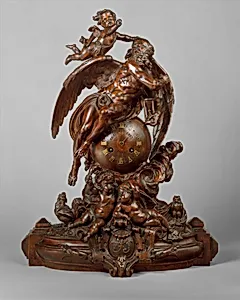
Albert-Ernest Carrier-Belleuse (1824–1887) was a prolific French sculptor whose versatile career bridged fine art and decorative arts, embodying the eclecticism of mid-19th-century France. Born on June 12, 1824, in Anizy-le-Château, Aisne, he began his training as a goldsmith's apprentice before studying under the renowned sculptor David d'Angers. He briefly attended the École des Beaux-Arts in Paris, honing skills that propelled him into international acclaim. Between 1850 and 1855, Carrier-Belleuse worked in England for the Minton porcelain factory, producing ceramic sculptures that showcased his mastery of modeled figures and ornamental motifs. His early style drew from neoclassical traditions but infused with a romantic sensuality, evident in graceful busts and allegorical groups that blended realism with decorative flair.
Returning to France, Carrier-Belleuse established a bustling studio where Auguste Rodin served as his assistant from 1864 to 1870. The two collaborated closely, with Rodin contributing to large-scale projects, before traveling together to Brussels around 1871. Carrier-Belleuse's output was immense: he crafted monumental public sculptures, intimate porcelain pieces for the Sèvres factory—where he later became artistic director—and elegant terracottas like *Abundantia* (1868) and *The Bather* (circa 1870s). His work for firms such as Guéret Frères and Vincenti et Cie further extended his influence into luxury porcelain and decorative objects, often featuring mythological women, children, and cherubs rendered with fluid, naturalistic anatomy. Appointed an officer of the Legion of Honour, he co-founded the Société Nationale des Beaux-Arts, championing progressive artistic institutions.
Carrier-Belleuse's legacy endures as a pivotal figure in 19th-century sculpture, bridging academic rigor with industrial design. His mentorship of Rodin, who credited him with technical foundations before forging his own path, underscores his role as a teacher and innovator. Though sometimes overshadowed by protégés, his contributions to Sèvres porcelain and public monuments—like fountains and architectural decorations—revived ornate styles amid Haussmann's Paris. Sons Louis-Robert and Pierre Carrier-Belleuse carried forward his legacy as painters and sculptors, ensuring the family's prominence in French art. Today, his works grace institutions like the Metropolitan Museum of Art and the National Gallery, celebrating a career of unyielding productivity and aesthetic refinement.