
Ctrl K
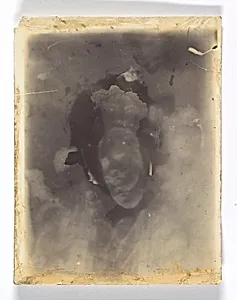
**Charles Lacey** was a British photographer active in the late 19th century, best known for his experiments with thoughtography, also called psychic photography. Working primarily between 1894 and 1898, he produced a series of small albumen and gelatin silver prints, approximately 4 by 3 inches, that he claimed captured projected mental images or psychic impressions directly onto photographic plates without the use of a camera lens in the conventional sense.
Little is documented about Lacey’s early life, training, or artistic influences. His work emerged during a period of widespread fascination with spiritualism and the paranormal, when photography was often enlisted to provide supposed visual evidence of unseen phenomena. The resulting images are abstract and ethereal, featuring faint, ghostly forms and patterns that Lacey attributed to thought projection.
A notable group of seven thoughtographs by Lacey resides in the collection of the Metropolitan Museum of Art, acquired as part of the Gilman Collection. These prints exemplify the intersection of early photographic technology and pseudoscientific inquiry at the fin de siècle.
Though obscure today, Lacey’s photographs remain intriguing artifacts of Victorian-era curiosity about the mind, the spirit, and the possibilities of the photographic medium. They continue to be studied by historians of photography and those interested in the cultural history of psychical research.
![[Thoughtograph, or Psychic Photograph]](https://images.artheonmuseum.org/met/ph/thumb/thoughtograph-or-psychic-photograph-286364.webp)
![[Thoughtograph, or Psychic Photograph]](https://images.artheonmuseum.org/met/ph/thumb/thoughtograph-or-psychic-photograph-775403.webp)
![[Thoughtograph, or Psychic Photograph]](https://images.artheonmuseum.org/met/ph/thumb/thoughtograph-or-psychic-photograph-775404.webp)
![[Thoughtograph, or Psychic Photograph]](https://images.artheonmuseum.org/met/ph/thumb/thoughtograph-or-psychic-photograph-775405.webp)
![[Thoughtograph, or Psychic Photograph]](https://images.artheonmuseum.org/met/ph/thumb/thoughtograph-or-psychic-photograph-775402.webp)
![[Thoughtograph, or Psychic Photograph]](https://images.artheonmuseum.org/met/ph/thumb/thoughtograph-or-psychic-photograph-775406.webp)