
Ctrl K
1739–1820
**Charles Paul Jérôme de Bréa** (1740–1820) was a French pastellist, miniaturist, engraver, and painter whose long career bridged the Rococo elegance of the Ancien Régime and the turbulent portraits of the Revolutionary era. Born in Rouen on 4 July 1740 into a family of Italian painters established in Chartres since the late seventeenth century, he had a cousin, Pierre-Raphaël Bréa, who may account for some early attributions. His early training remains undocumented before his arrival in Paris around 1770, as noted in his first wife Marie-Jeanne Brierre's death certificate that year. By then, Bréa had caught the eye of leading artists: Swedish enameler Peter Adolf Hall portrayed him in his earliest enamel in 1771 (Louvre), and Jean-Honoré Fragonard depicted him around 1769 as one of his whimsical *figures de fantaisie* (Louvre), bequeathed by Bréa to painter Jean-Claude Naigeon.
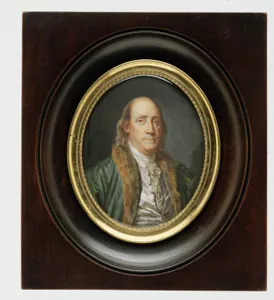
In 1771, Bréa joined the Académie de Saint-Luc as a "peintre en huile et au pastel," announcing in the *Mercure de France* his invention of a secret method to fix pastels and drawings, complete with a printed label on his *Venus and a Nymph Confiscating Cupid’s Arrows* (pastel, 59x47 cm, signed and dated 1771). He worked closely in the style of Hall, producing miniatures, enamel portraits, and *figures de fantaisie* genre scenes, while dealing in Old Master paintings—he bought lots from the Duc de Choiseul's 1772 sale for the Prince de Conti. Bréa also experimented with mezzotint engraving, creating portraits like Benjamin Franklin after Jean-Baptiste Greuze (ivory miniature, 1777; Metropolitan Museum of Art).
The French Revolution elevated Bréa’s profile through portraits of luminaries: he sketched Charlotte Corday on 17 July 1793, hours before her execution, and produced pastels of revolutionaries like Mirabeau, Robespierre, and Emmanuel-Joseph Sieyès (a friend), some engraved by Johann Heinrich Lips. Standout works include the oval pastel pair of Michel-Philippe "Théophile" Mandar and his wife (54x44.5 cm and 54x44 cm, signed "Bréa 1792"; Musée Carnavalet), mathematician Emmanuel-Étienne Duvillard de Durand (1814), and philosopher Pierre Laromiguière (60x49 cm, 1813; Versailles). Granted 2,000 livres by the Convention in 1795 and serving as *messager d’état* under the Empire, he continued pastels into his eighties, signing a portrait of Mlle Renée Casselle in 1765 (though possibly early cousin's work).
Bréa’s legacy endures as an innovator who stabilized pastels for permanence and captured Revolutionary icons amid political upheaval, though some critics deemed his later portraits mediocre. His dual roles as artist, dealer, and fixer of Vigée Le Brun’s émigré status (1799 petition) reflect a resilient figure in Paris’s art world until his death on 4 September 1820.
All 1 artworks loaded