
Ctrl K
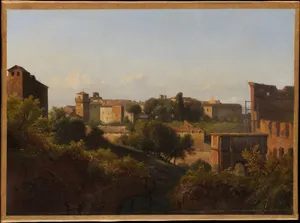
1795–1875
Jean-Charles-Joseph Rémond, often known simply as Charles Rémond, was born in Paris on 19 April 1795, the son of a printer who specialized in engravings. He began his artistic training early, studying under the history painter Jean-Baptiste Regnault at the Académie royale de peinture et de sculpture from 1809, before entering the École des Beaux-Arts in 1814 as a pupil of the neoclassical landscape specialist Jean-Victor Bertin. There he encountered fellow student Achille-Etna Michallon. Rémond made his Salon debut that same year with two historical landscapes, signaling his commitment to a genre that blended narrative subjects with carefully observed nature.
In 1821 he won the prestigious Prix de Rome for historical landscape unanimously with *The Abduction of Proserpine by Pluto*, a work that secured his four-year sojourn at the French Academy in Rome. During this period and subsequent travels through Italy (including Naples and Sicily), Switzerland, and France, Rémond developed a practice of plein-air oil sketches on paper, capturing luminous atmospheric effects and topographic details that he later incorporated into larger studio compositions. His style remained rooted in the neoclassical tradition of Bertin, emphasizing balanced compositions, muted yet harmonious color, and a sense of historical or poetic grandeur, while his Italian views—such as *View of Ischia from the Sea* (1842)—reveal a growing sensitivity to natural light and volcanic drama. He also produced lithographic albums of Italian scenery published in the late 1820s.
Upon returning to Paris in 1826, Rémond opened a successful studio that became known for preparing students for the Prix de Rome. Among his pupils was the young Théodore Rousseau, who joined in late 1826 and absorbed Rémond’s emphasis on direct study of nature even as he later pioneered the more rustic Barbizon approach. Rémond himself published instructional treatises, including *Principes de paysages* (1826) and *Cours complet de paysages* (1828). He continued to exhibit historical landscapes and battle scenes (several now at Versailles) until 1848, earning Salon medals in 1819 and 1827 and appointment as an officer of the Légion d’honneur. Notable works include *Carloman Mortally Wounded in the Forest of Yvelines* (Louvre) and *Ulysses and Nausicaa* (Nantes). He died in Paris on 9 July 1875. Through his teaching and his own refined landscapes, Rémond helped transmit academic landscape principles to a generation that would transform the genre.
All 1 artworks loaded