Ctrl K
1838–1912
Occupations
Toyohara Chikanobu (1838–1912), better known to his contemporaries as Yōshū Chikanobu, was a prolific Japanese woodblock artist whose career bridged the collapse of the Tokugawa shogunate and the modernization of Meiji Japan. Before becoming an artist, Chikanobu fought as a samurai retainer for the Sakakibara clan, participating in the doomed resistance at the Battle of Hakodate where Tokugawa loyalists made their final stand. After military defeat, he turned to art at age thirty-seven, studying ukiyo-e techniques with masters Kuniyoshi and Kunisada. Chikanobu became renowned for his bijinga (images of beautiful women), documenting the dramatic transformation of Japanese women's fashion as traditional kimono coexisted with Western dress during the Meiji period. His vast output ranged from historical battles to court life to mythology, making him one of the most versatile ukiyo-e artists of the late 19th century.
Born in 1838, Chikanobu served as a retainer of the Sakakibara clan of Takada Domain in Echigo Province (present-day Niigata Prefecture). As a child, he received training in Kano school painting, the official style favored by the samurai class, learning traditional techniques of brush painting and composition.
When the Tokugawa shogunate collapsed in 1868, Chikanobu joined the Shōgitai, a corps of Tokugawa loyalists who resisted the Meiji Restoration. He fought in the Battle of Ueno in Edo (Tokyo), where government forces crushed the resistance.
Refusing to surrender, Chikanobu joined other loyalists who retreated to Hakodate in Hokkaido under the leadership of Enomoto Takeaki and Ōtori Keisuke. There he fought in the Battle of Hakodate at the Goryōkaku star fort, the final conflict of the Boshin War. Chikanobu achieved recognition for his bravery during this desperate last stand of the Tokugawa cause.
After the loyalists' defeat in 1869, Chikanobu faced an uncertain future. The samurai class was being systematically abolished, and former Tokugawa supporters were politically marginalized. In 1875, at age thirty-seven, he made the decisive choice to become a professional artist.
Moving to Tokyo, Chikanobu sought training in ukiyo-e, the popular woodblock print tradition. He first studied at the studio of Kuniyoshi Utagawa (1797–1861), though this must have been through Kuniyoshi's legacy and former students, as Kuniyoshi had died in 1861. He later trained with Kunisada I Utagawa (1786–1865), again likely through that master's tradition as Kunisada had also passed away before Chikanobu's artistic career began.
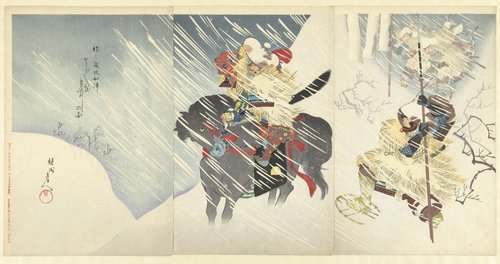
Chikanobu brought his Kano school training and samurai background to ukiyo-e, creating a distinctive approach. His early works often depicted military subjects, drawing on his own battlefield experiences and his knowledge of warrior culture.
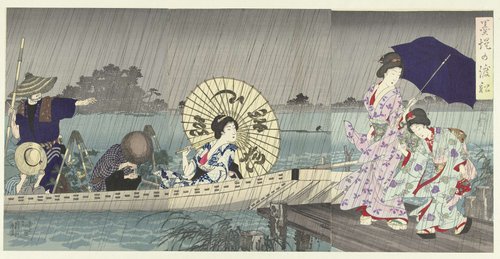
Chikanobu became best known as a master of bijinga, images of beautiful women. The Meiji period witnessed dramatic social changes, including the transformation of women's roles and fashion. Chikanobu documented these changes with remarkable thoroughness, showing women in both traditional kimono and newly adopted Western dress.
His works depicted women across various social contexts: aristocratic court ladies, geisha, ordinary townswomen, and even factory workers. This comprehensive approach made his prints valuable documents of social history as well as accomplished artworks.
Like many ukiyo-e artists, Chikanobu worked across diverse subjects. He created series depicting Japanese mythology, historical battles (including those from his own military experience), scenes of the Imperial court, and views of modern Tokyo. His print series often comprised dozens of related images, demonstrating both his productivity and his systematic approach to documenting contemporary life.
Chikanobu maintained his artistic activity until his death from stomach cancer in 1912 at age seventy-five, having witnessed Japan's transformation from feudal isolation to modern imperial power.
Artheon Research Team
Last updated: 2025-11-09
Biography length: ~497 words
Wikidata (CC0); Getty ULAN (ODC-By)