
Ctrl K
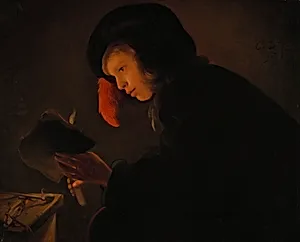
Christiaen Jansz. Dusart (1618–1683) was a Dutch painter and draughtsman active during the Golden Age. Born in Antwerp on 25 February 1618, he later settled in Amsterdam, where he married in 1642 and spent much of his career. While details of his early training remain undocumented, he worked primarily as a painter of portraits, history paintings, and still lifes, with rare examples in pastel. He also supplemented his artistic income through the dyeing of fabrics, a trade he shared with family members.
Dusart’s style reflects the intimate, atmospheric qualities of 17th-century Dutch art. His best-known work, *Young Man by Candlelight* (1645), now in the Rijksmuseum, Amsterdam, demonstrates his skill in capturing dramatic lighting and contemplative mood. He also produced notable portraits, including one of Henry Cromwell dated 1655, held in the Cromwell Museum, and another of Jan Rippertsz. van Groenendyck in the Fitzwilliam Museum. These works highlight his ability to render character and texture with precision.
Dusart’s legacy is closely tied to his family connections in the art world. He was the uncle of the more prominent painter Cornelis Dusart (1660–1704), whose genre scenes and drawings achieved greater fame. Though his own output was relatively modest and his pastels especially scarce, Dusart contributed to the rich tradition of Dutch portraiture and candlelit genre scenes that flourished in the mid-17th century. His works continue to appear in museum collections, offering insight into the quieter corners of the Dutch Golden Age.