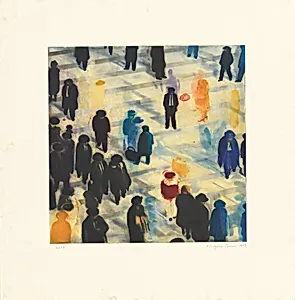
Christopher Brown was born in 1951 at Marine Corps Base Camp Lejeune in Jacksonville, North Carolina, and grew up in Warren, Ohio, and Urbana, Illinois. He earned a B.A. from the University of Illinois Urbana-Champaign in 1973, then pursued graduate study at the University of California, Davis, receiving his M.F.A. in 1976. At Davis he studied under three formative California artists—Wayne Thiebaud, William T. Wiley, and Roy De Forest—each of whom modeled a distinct way of navigating the relationship between representation, vernacular culture, and imaginative freedom.
Brown's paintings are associated with neo-expressionism, though his approach is singular: large-scale canvases built from memory rather than direct observation, occasionally supplemented with photographic reference, and organized around collage-like juxtapositions of figurative images and abstract or patterned backgrounds. His compositions create a sense of temporal displacement and psychological unease, placing figures in dreamlike spaces that resist stable narrative. He has returned repeatedly to historical photographs and media images as source material, including an extended series of Civil War paintings developed from a photograph of the Gettysburg Address, and a body of work responding to images of the Kennedy assassination.
Brown launched his professional career with a solo exhibition at Gallery Paule Anglim in San Francisco in 1977. He joined the faculty of the University of California, Berkeley, in 1981 and served as Professor and Department Chair until 1994, subsequently teaching as an adjunct professor at the California College of the Arts. His first major traveling museum retrospective, History and Memory: Paintings by Christopher Brown, was organized by the Modern Art Museum of Fort Worth in 1995.
Brown's work is held in the collections of the Metropolitan Museum of Art, the San Francisco Museum of Modern Art, the Cleveland Museum of Art, the National Gallery of Art, and the Minneapolis Institute of Art, among other institutions. He continues to be recognized as a significant figure in American painting, whose layered, memory-based canvases probe the way images from history and mass media lodge in the mind and resist straightforward interpretation.

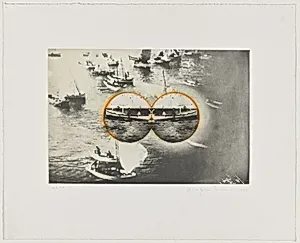
![Atlantic Crossing [preparatory drawing]](https://images.artheonmuseum.org/nga/thumb/atlantic-crossing-preparatory-drawing-nga-230159.webp)
![Atlantic Crossing [preparatory drawing]](https://images.artheonmuseum.org/nga/thumb/atlantic-crossing-preparatory-drawing-nga-230160.webp)
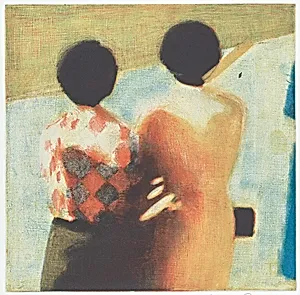
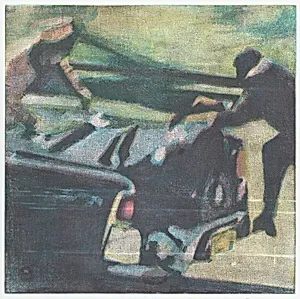
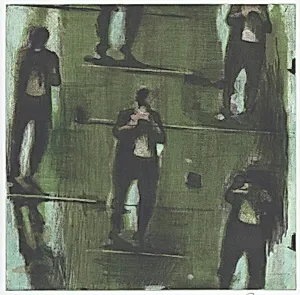
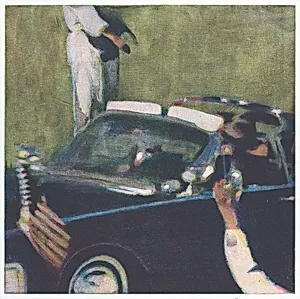
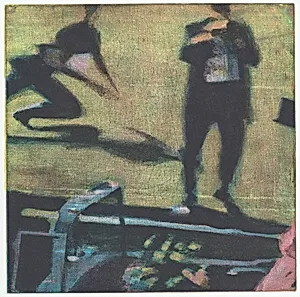
![Sheet Music [working proof 10]](https://images.artheonmuseum.org/nga/thumb/sheet-music-working-proof-10-nga-230223.webp)
![Sheet Music [working proof 24]](https://images.artheonmuseum.org/nga/thumb/sheet-music-working-proof-24-nga-230224.webp)
![Eighty Second Street [working proof 3]](https://images.artheonmuseum.org/nga/thumb/eighty-second-street-working-proof-3-nga-230164.webp)
![Station [working proof 24]](https://images.artheonmuseum.org/nga/thumb/station-working-proof-24-nga-230212.webp)
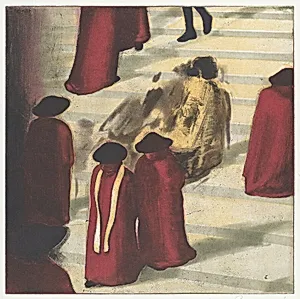
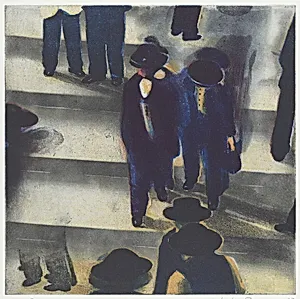
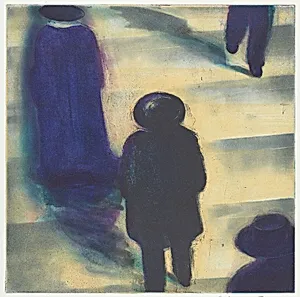
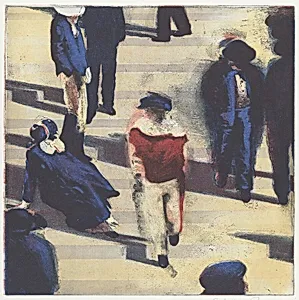
![Eighty Second Street [working proof 1]](https://images.artheonmuseum.org/nga/thumb/eighty-second-street-working-proof-1-nga-230163.webp)
![Eighty Second Street [working proof 5]](https://images.artheonmuseum.org/nga/thumb/eighty-second-street-working-proof-5-nga-230166.webp)
![Eighty Second Street [working proof 4]](https://images.artheonmuseum.org/nga/thumb/eighty-second-street-working-proof-4-nga-230165.webp)
![Eighty Second Street [working proof 6]](https://images.artheonmuseum.org/nga/thumb/eighty-second-street-working-proof-6-nga-230167.webp)
![Eighty Second Street [working proof 7]](https://images.artheonmuseum.org/nga/thumb/eighty-second-street-working-proof-7-nga-230168.webp)
![Eighty Second Street [working proof 8]](https://images.artheonmuseum.org/nga/thumb/eighty-second-street-working-proof-8-nga-230169.webp)
![Eighty Second Street [working proof 10]](https://images.artheonmuseum.org/nga/thumb/eighty-second-street-working-proof-10-nga-230170.webp)