Christopher Wilmarth (1943–1987) was a visionary American sculptor whose ethereal works captured the interplay of light and shadow through glass and steel. Born on June 11, 1943, in Sonoma, California, he grew up in Sonoma County and Palo Alto before moving to New York City in the early 1960s. There, he honed his craft at The Cooper Union, earning a B.F.A. in 1966. Wilmarth's early career included a stint as studio assistant to Tony Smith, immersing him in the New York art scene amid Minimalism's rise. His first solo exhibition came in 1968 at the Graham Gallery, followed by shows at Paula Cooper Gallery in 1971 and 1972.
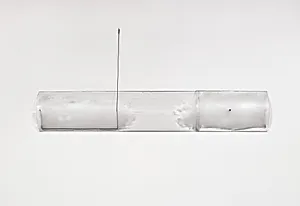
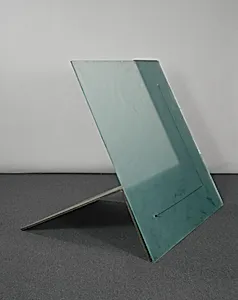
Working in the Minimalist tradition yet infusing it with romantic lyricism, Wilmarth transformed industrial materials—etched plate glass treated with hydrofluoric acid and taut steel cables—into poetic evocations of light, gravity, and emotion. Influenced by Constantin Brâncuși, Henri Matisse, poets like Stéphane Mallarmé, and even country musician Hank Williams, his sculptures blurred sculpture and drawing, refracting natural hues of blue and green to create immersive "places to generate experience." Breakthrough series like *Nine Clearings for a Standing Man* (1973), featuring bent steel behind subtly etched glass, and *Six Clearings for Hank Williams* (1973) marked his mastery, with pieces entering collections at MoMA and the Whitney by his early thirties.
In 1978, disillusioned with commercial galleries, Wilmarth founded the Studio of the First Amendment for independent shows, unveiling ambitious bodies of work like the *Gnomon’s Parade* sculptures (1980), *Breath* series (1982, tied to Mallarmé illustrations), *Layers* (1984), and *Delancy Backs* (1986). He taught sculpture at Cooper Union and Columbia University, mentoring a new generation. Married to Susan Wilmarth-Rabineau, who later donated his vast archive to Harvard Art Museums, Wilmarth tragically died by suicide on November 19, 1987, at age 44 in Brooklyn.
Wilmarth's legacy endures through approximately 150 sculptures in prestigious institutions worldwide, including the Art Institute of Chicago, Tate, and Metropolitan Museum. Posthumous retrospectives, such as MoMA's 1989 exhibition and Harvard's 2017 *Reverie: Christopher Wilmarth, Before and After Mallarmé*, affirm his profound innovation in glass sculpture, bridging Minimalism's austerity with deeply felt humanism.