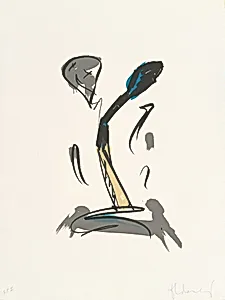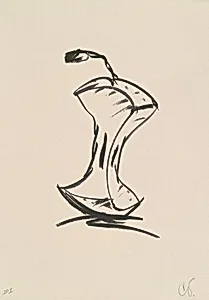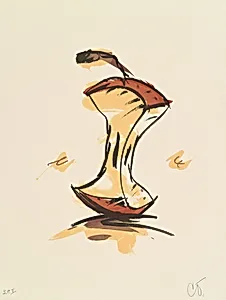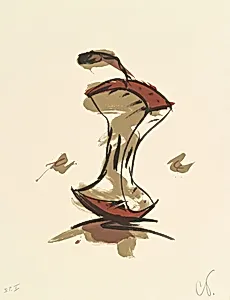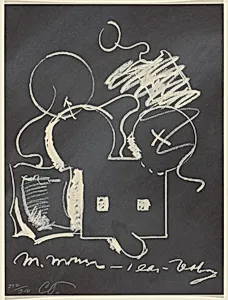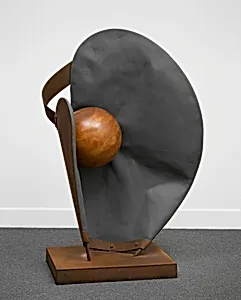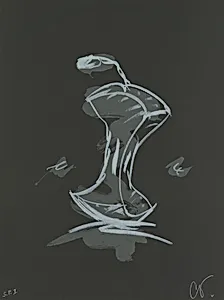
Claes Oldenburg, born January 28, 1929, in Stockholm, Sweden, to diplomat Gösta Oldenburg and Sigrid Elisabeth Lindforss, spent much of his childhood abroad before his family settled in Chicago in 1936, where his father served as Swedish consul general. He attended the Latin School of Chicago, then studied literature and art history at Yale University from 1946 to 1950, followed by classes at the School of the Art Institute of Chicago while working as a reporter. Naturalized as a U.S. citizen in 1953, Oldenburg moved to New York in 1956, immersing himself in the city's vibrant scene at the Cooper Union library and Judson Memorial Church, where he connected with Allan Kaprow, Jim Dine, and others in the nascent Happenings movement—raw, theatrical performances rejecting Abstract Expressionism.
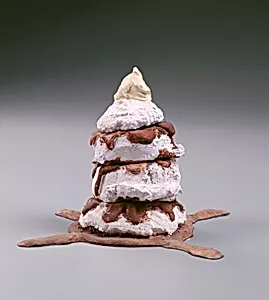
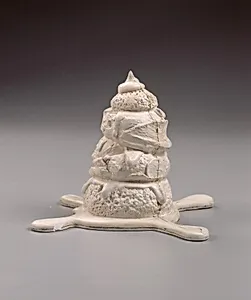
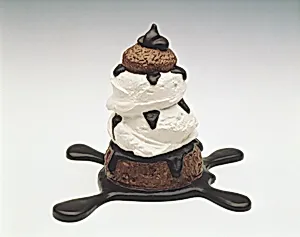
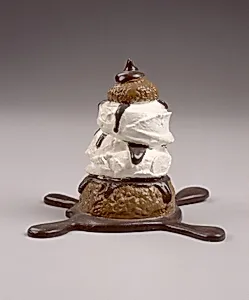
Oldenburg's breakthrough came with soft sculptures in the early 1960s, aligning him with Pop Art through oversized, pliable renditions of consumer goods that evoked humor, sexuality, and absurdity. His first wife, Patty Mucha (married 1960–1970), sewed pieces like *Floor Cake* (1962) and *Floor Cone*, displayed in his immersive installation *The Store* (1961) on Manhattan's Lower East Side. Works such as *Pastry Case, I* (1961–62) and *Giant Toothpaste Tube* (1964) used fabric, vinyl, and latex to deflate everyday objects—hamburgers, toilets, fans—challenging sculpture's rigidity and celebrating mass culture's banality.
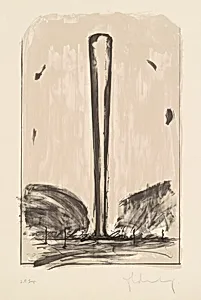
From the 1970s, Oldenburg pivoted to monumental public commissions in hard materials like steel and aluminum, often collaborating with his second wife, Coosje van Bruggen (married 1977; she died 2009), on over 40 projects blending whimsy and site-specificity. Iconic examples include *Lipstick (Ascending) on Caterpillar Tracks* (1969, Yale University), an anti-war symbol; *Clothespin* (1976, Philadelphia); *Batcolumn* (1977, Chicago); *Spoonbridge and Cherry* (1988, Minneapolis Sculpture Garden); *Typewriter Eraser, Scale X* (1999, Washington, D.C.); and *Dropped Cone* (2001, Cologne). These giants transformed urban spaces, making the mundane heroic.
Oldenburg's legacy endures in his reinvention of sculpture—soft, sagging forms yielding to colossal tributes to Americana—paving the way for artists like Jeff Koons and influencing public art's accessibility and irony. Retrospectives at MoMA, Guggenheim, and Whitney underscored his enduring impact until his death on July 18, 2022.