Ctrl K
Constantin Mitrofanovitsh Flórinsky was a Russian photographer active in the early 20th century, renowned for his pioneering use of the autochrome process, one of the first practical methods for color photography introduced by the Lumière brothers in 1904. Serving as an officer in the Jaeger Regiment under Tsar Nicholas II, Flórinsky captured intimate glimpses of Imperial Russian life on the eve of the 1917 Revolution. His early life and formal training remain not well documented, with no records of specific art schools, mentors, or prior photographic studies emerging from historical sources. This scarcity underscores his status as a relatively obscure yet technically adept practitioner amid Russia's burgeoning photographic scene.
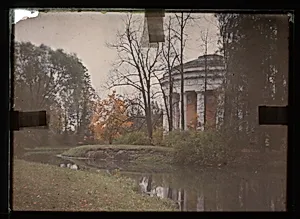
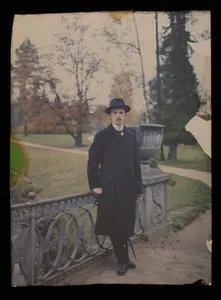
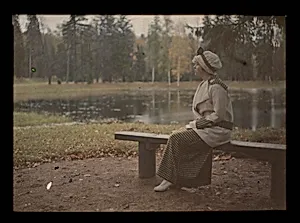
Flórinsky's surviving oeuvre is exemplified by three exquisite autochromes held in The Metropolitan Museum of Art's collection, all created in 1907 and acquired through the David Hunter McAlpin Fund in 1961. His self-portrait, *Constantin Mitrofanovitch Flórinsky, Officer of His Majesty Tzar Nicholas II (Jaeger Regiment)* (12.3 x 9.1 cm), depicts him in full military regalia, the vibrant reds of his uniform and insignia popping against a neutral backdrop, evoking the grandeur of the Tsarist era. *Temple of Amour* (9 x 11.9 cm) presents a neoclassical sculpture bathed in soft, luminous tones, highlighting his skill in rendering three-dimensional forms through the autochrome's starch-grain technique. The portrait *Olga Victorovna Dmitrieff* (9 x 12 cm) captures a poised young woman in elegant attire, her skin and fabrics rendered with delicate color gradations that foreshadow modern photography.
Working in the realist tradition of early color photography, Flórinsky eschewed artistic movements like Symbolism or Impressionism, instead prioritizing technical precision and naturalistic hues to document portraits and still lifes. His autochromes, as glass-plate transparencies, demanded meticulous exposure and development, reflecting a scientific rigor akin to contemporary pioneers like Sergei Prokudin-Gorsky.
Though sparsely represented in major collections, Flórinsky's legacy endures as a window into pre-revolutionary Russia's elite society. His vivid, color-saturated images preserve the opulence of military uniforms, aristocratic poise, and classical motifs, offering invaluable historical testimony. Today, these works educate viewers on the autochrome's transformative role in visual culture, bridging monochrome photography and full-spectrum color.