
Ctrl K
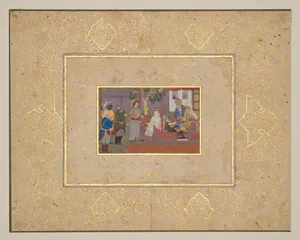
1570–1660
**Muhammad Daulat** (or Dawlat) was a leading Mughal painter whose career spanned the reigns of emperors Akbar, Jahangir, and Shah Jahan. Active on imperial commissions from about 1595 to roughly 1635–1640, he ranks among the most accomplished artists of the Mughal atelier.)
Born into a family of court painters, Daulat was the son of L’al, who served in the imperial workshop, and the brother of the artist Daud. He trained in the Mughal imperial studio and was influenced by the great master Basawan. Early in his career he contributed to large narrative scenes in major manuscripts, later specializing in sensitive portraits before focusing on elaborate ornamental borders for miniatures.)
Daulat’s style is marked by clusters of narrow-shouldered, voluminous figures, a bright palette with pronounced contour shading, and individualized facial types featuring dark features, full cheeks, and large, staring eyes. He displayed unusual self-consciousness for his time, inserting hidden signatures and creating rare self-portraits at the emperor’s request. Notable examples include his self-portrait on a page of the Gulshan Album (c. 1610, Golestan Palace Library, Tehran) and the double portrait of himself painting the calligrapher ʿAbd al-Rahim added to the Khamsa of Nizami (British Library). He contributed to important projects such as the Akbarnama, Razmnama, Baburnama, the Windsor Padshahnama, and the Kevorkian Album, and was also skilled in gold illumination.
Daulat’s legacy lies in his technical mastery, his documentation of fellow artists, and his elevation of the painter’s presence within Mughal manuscripts. His work exemplifies the refined, courtly aesthetic of Mughal painting at its height and remains prized in major collections worldwide.
All 1 artworks loaded