Ctrl K
1800–1889
David Daniel Haring (1800–1889) was born into a prominent Dutch-American family in the Tappan area of Rockland County, New York, the son of David A. Haring (1760–1801) and Maria Alyea (1775–1863). Descended from early immigrant Jan Haring (1633–1683), he grew up amid the tight-knit communities of Bergen County, New Jersey, and neighboring New York, where textile traditions thrived among Dutch descendants. Early life details beyond parentage remain sparsely documented, but Haring primarily worked as a farmer while mastering Jacquard loom weaving, a technology introduced to America around 1826 that enabled intricate, reversible patterns via punch cards.
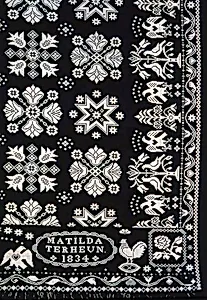
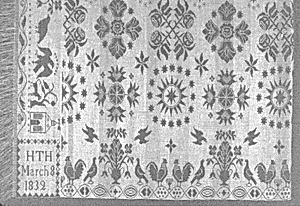
Haring specialized in double-cloth coverlets—figured and fancy weaves typically using blue wool against undyed cotton—producing personalized pieces for clients, often family members, with signatures, dates, and names woven in cartouches. His trademark rose motif with four leaves adorned the corners of many works. Active from at least 1832 to 1838, he wove in Harrington Township, Bergen County (near present-day West Norwood), and Tappan, creating custom orders like bridal "outfits" or trousseaus. Notable examples include a 1832 coverlet attributed to him at the Art Institute of Chicago, featuring eagles, floral vases, and birds; a 1834 doublecloth coverlet at the Metropolitan Museum of Art with roosters and stars; and a circa 1836 crib coverlet, likely for his cousin Rachel Blauvelt (1818–1899) as a wedding gift before her 1838 marriage to Peter T. Haring. Additional pieces reside in the Smithsonian, Henry Ford Museum, and McCarl Coverlet Gallery (five examples).
As the best-documented New Jersey coverlet weaver, Haring trained apprentices who perpetuated Bergen County's folk textile tradition into later decades, blending European Dutch techniques with American innovation. His ornate, symmetrical designs—eagles, flowers, animals—reflected ceremonial family customs and regional pride. At death in 1889, his estate exceeded $45,000 (over $1.5 million today), bolstered by land and weaving commissions. Haring's legacy endures in museum collections, illuminating 19th-century rural craft and the Jacquard era's democratization of complex weaving for everyday artistry.