
Ctrl K
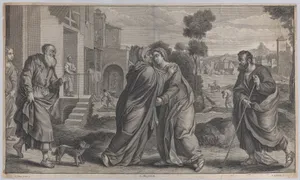
**David Teniers the Younger** (1610–1690) was one of the most prolific and versatile Flemish Baroque painters of the seventeenth century. Born in Antwerp on 15 December 1610 as the son of painter David Teniers the Elder, he trained under his father from around 1626 and registered as a master in the Antwerp Guild of Saint Luke in 1632–33.
His early career was shaped by family collaboration and the need to support his father’s financial difficulties through copies of old masters. Teniers married Anna Brueghel, daughter of Jan Brueghel the Elder, in 1637 (with Peter Paul Rubens as a witness), which strengthened his ties to Antwerp’s artistic elite. He later moved to Brussels around 1650 to serve as court painter and curator of the renowned art collection of Archduke Leopold Wilhelm of Austria, for whom he compiled the influential printed catalogue *Theatrum Pictorium* (1660).
Teniers excelled across genres but became best known for his innovative peasant scenes, tavern interiors, alchemist laboratories, and depictions of art collections. He also painted religious subjects such as numerous versions of *The Temptation of St. Anthony*, history paintings, landscapes, and portraits. His style evolved from the small-scale cabinet pictures influenced by Adam Elsheimer (via his father) to larger, more luminous compositions that captured everyday life with humor and meticulous detail.
In his later years, Teniers founded the Antwerp Academy of Fine Arts in 1665 to revive Flemish artistic traditions after the deaths of Rubens and van Dyck. He influenced subsequent Northern genre painters and even French Rococo artists such as Antoine Watteau. Teniers died in Brussels on 25 April 1690, leaving a vast legacy of roughly two thousand paintings that continue to define seventeenth-century Flemish genre painting.