
Ctrl K
1700–1749
Ding Liangxian (丁亮先, ca. 1685–after 1754), styled Yingzong (应宗), was a pioneering figure in Qing dynasty woodblock printing, born in Suzhou and later residing in the Jia Shu Xuan studio in Qiantang (modern Hangzhou). A devout Catholic amid a group of Christian artists, he sustained himself primarily by trading Western paintings while excelling as a versatile printmaker in the vibrant Gusu ban (Suzhou print) tradition. His career bridged commercial workshops and artistic innovation during the Kangxi to Qianlong eras, with his family's Suzhou studio peaking between the 1720s and 1760s.
Little is known about Ding's early training, as historical records focus more on his mature output than formative influences. Nonetheless, his technical mastery—employing multi-block color overprinting (taose taoyin), rainbow printing (dou版), and embossed gauffrage (gonghua or "arched flower") for vivid texture and depth—echoed Ming precedents like Hu Zhengyan's *Shizhu Zhai Jianpu* while incorporating subtle Western shading and perspective, likely gleaned from his dealings in European art. Working from the Ding clan workshops, he produced single-sheet prints of auspicious motifs: flowers, birds, fruits, insects, and antiques symbolizing prosperity and harmony. These blended Jiangnan literati elegance with popular appeal, often signed "Gusu Ding Liangxian zhi" (Made by Ding Liangxian of Suzhou).
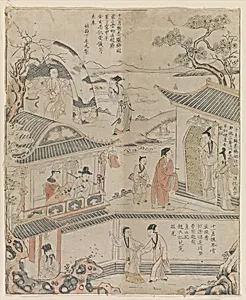
Among his masterpieces are the *Twelve Months Tea Picking Song Pictures* (ca. 1730s), a Jiangnan landscape series now in the British Museum; *Ink Bamboo Spectrum* (1712), an early multi-color work based on Ma Yu's designs; and floral compositions like *Pomegranate Flower with Bird*, *Magpies*, and *Lotus Flower* (1735–1750), held in institutions such as the Metropolitan Museum, Cleveland Museum of Art, and British Museum. The Met's *The Last Three Months of the Year* from his workshop exemplifies seasonal themes with polychrome vibrancy.
Ding's legacy endures through over 149 surviving prints, exported via maritime routes to Japan and Europe, where they inspired ukiyo-e artists like Kitagawa Utamaro and entered elite collections like that of Sir Hans Sloane. His fusion of Chinese refinement and global techniques elevated commercial Gusu prints to high art, influencing cross-cultural exchange and modern scholarship on Qing visual culture.