
Ctrl K
1543–1543
**Domenico Dalle Greche** (also spelled Delle Greche) was an Italian painter, wood-engraver, and print publisher of Greek origin active in Venice during the mid-16th century. Born in Modone (modern Methoni) in the Peloponnese as the son of the Venetian Antonio, he worked primarily between 1543 and 1558. No paintings by him survive, and his reputation rests on his skill as a reproductive printmaker and publisher who translated designs by leading Venetian artists into woodcuts.
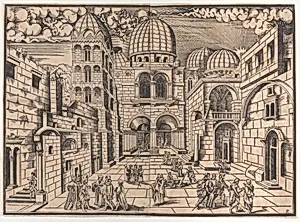
Dalle Greche belonged to the circle of engravers surrounding Titian, specializing in large-scale woodcuts that captured the master’s dynamic compositions. His most celebrated achievement is the 1549 edition of Titian’s monumental twelve-block woodcut *The Submersion of Pharaoh’s Army in the Red Sea*, a technically ambitious project that helped disseminate Titian’s imagery across Europe. He also produced other prints after Titian, including the *Lamentation* and *Christ Shown to the People*. In 1546, following a pilgrimage to the Holy Land, he obtained a Venetian Senate privilege to publish a series of drawings made during his journey; the resulting woodcut *The Church of the Holy Sepulchre, Jerusalem* (ca. 1546) remains one of his best-known independent works.
Beyond Titian-related projects, Dalle Greche supplied illustrations for travel accounts, such as the 1547–48 *Itinerarium* of the Bohemian noble Ulrich von Wilkenau, and contributed botanical drawings to the codices of the Venetian naturalist Pietro Antonio Michiel. He also created maps and views of Venice and Cairo that appeared in contemporary cosmographies. Historical records note that he had a son, Aurelio, who likewise pursued a career as a painter.
Though his personal artistic output was modest in scale, Dalle Greche played a significant role in the vibrant Venetian print culture of the Renaissance. His editions helped preserve and popularize major compositions by Titian while documenting pilgrimage sites and natural history for a wider audience. Today his surviving woodcuts are held in major collections, including the Metropolitan Museum of Art, and continue to be valued for their historical and technical interest.
No artworks found for this artist