
Ctrl K
**Donald McDonnell: Pioneer Daguerreotypist of the American Frontier**
Donald McDonnell emerged as one of the earliest practitioners of photography in the United States during the mid-19th century, specializing in the daguerreotype process that captured the raw detail of his subjects with mirror-like precision. Active primarily in Buffalo, New York, from the late 1840s, he established himself as a daguerreian artist and stock depot proprietor, operating at addresses like 194 Main Street between 1848 and 1852. Little is known of McDonnell's early life or formal training, as records from this nascent era of photography remain sparse; he likely honed his skills through self-directed experimentation during the daguerreotype's rapid adoption following its public introduction in 1839. His work reflects the pioneering spirit of early American photography, blending portraiture with documentary impulses amid the expanding frontiers of the Northeast and Upper Canada.
McDonnell's career in Buffalo positioned him at the heart of a burgeoning photographic community. He engaged in a professional rivalry with fellow daguerreotypist William Evans before the two collaborated to found the New York State Daguerreotype Association in the early 1850s—the first professional photographic organization in the United States. Together and individually, they garnered international acclaim and awards, elevating daguerreotypy from novelty to respected art form. McDonnell's studio, later known as Donald McDonnell & Co., catered to a clientele seeking precise likenesses, from postmortem portraits to images of notable travelers.
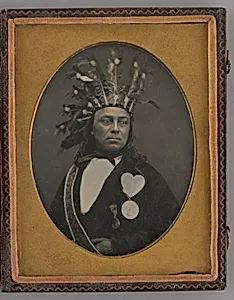
Among his surviving major works is a poignant postmortem daguerreotype from 1848, the earliest known extant example by McDonnell, donated to the Buffalo History Museum in 1867. He also produced what is considered the oldest photograph of Buffalo: a daguerreotype of the ruins of the American Hotel. Striking portraits of Ojibwe performer Indian Chief Maungwudaus from Upper Canada survive in two versions—one dated 1855 at the Art Institute of Chicago and another circa 1850–1851 (half-plate, 5½ × 4 inches) at the Nelson-Atkins Museum of Art—showcasing McDonnell's ability to render Indigenous subjects with dignified clarity amid their tours in North America.
McDonnell's legacy endures as a foundational figure in American photography, bridging the technical innovations of Europe with the documentary needs of a growing nation. His Buffalo-based endeavors helped professionalize the medium, paving the way for later photographers, though his personal details fade into the silvered plates he mastered. Today, his rare images in prestigious collections offer invaluable glimpses into 19th-century life, from urban ruins to cultural encounters.