Ctrl K
1855
Dorothy M. Gerhard was an American artist active around 1935 whose precise documentary drawings form a small but distinctive part of one of the most ambitious visual archives of the New Deal era. Her early life, training, and personal circumstances are not well documented, and no records of a specific teacher, art school, or formal movement affiliation have come to light. What survives of her work places her firmly among the hundreds of artists employed by the Index of American Design, a Federal Art Project of the Works Progress Administration.
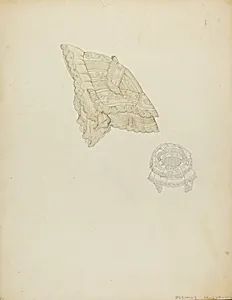
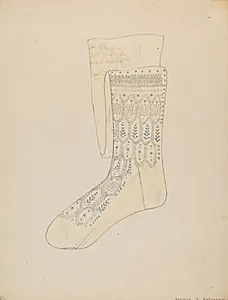
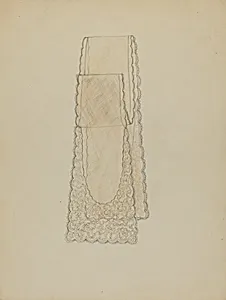
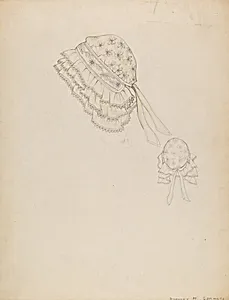
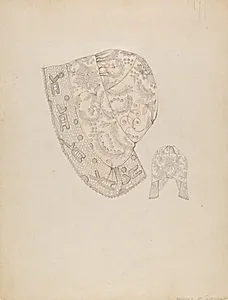
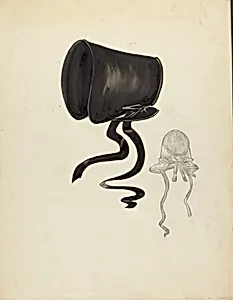
The Index, launched in 1935, set out to record the “practical, popular and folk arts” of the United States through more than 18,000 meticulous watercolor and graphite renderings of objects made before about 1890. Artists worked from actual artifacts—often loaned by private owners, museums, or antique dealers—producing plates intended for portfolios that would inspire contemporary design and preserve a national aesthetic. Gerhard’s surviving plates concentrate on historic clothing accessories: several 19th-century bonnets, a cap, a pair of stockings, and a small cravat, all executed between 1935 and 1942. These sheets, now in the National Gallery of Art, display the project’s hallmark combination of scientific accuracy and quiet artistry—every stitch of lace, every fold of ribbon, and every knitted pattern rendered with painstaking clarity.
Her six known works in public collections—Cap (c. 1940), Stockings (c. 1936), and four variations of Bonnet and Small Cravat (1935–1942)—exemplify the Index’s dual purpose of documentation and aesthetic appreciation. Drawn on paperboard in graphite and watercolor, they isolate each object against a neutral ground so that construction details become the subject itself. The result is both a historical record and a celebration of anonymous craftsmanship, particularly the intricate needlework that defined American women’s dress in the nineteenth century.
Although Gerhard’s individual career remains obscure, her plates endure as part of a collection that constitutes roughly 12 percent of the National Gallery’s holdings and continues to serve historians, costume designers, and contemporary artists. In an era when many such objects have vanished or deteriorated, her drawings keep their textures, colors, and construction techniques visible and usable, fulfilling the Index’s original hope of making America’s material past a living resource.
All 6 artworks loaded