
Ctrl K
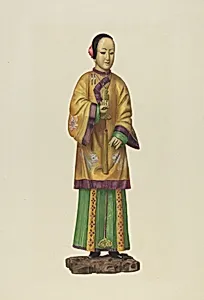
Dorothy Van Dunker and John W. Kelleher were American artists active in the 1930s who collaborated on works documenting American folk and commercial design. Their partnership is best known through a single surviving piece held in a major public collection, reflecting the era’s emphasis on preserving vernacular visual culture amid the Great Depression. Both contributed to federal art initiatives that recorded everyday objects and signage from earlier periods of American history.
Their primary known work, *Tea Importer’s Sign* (c. 1939), is executed in watercolor, graphite, and colored pencil on paperboard. Created as part of the Index of American Design project, the drawing meticulously reproduces a nineteenth-century trade sign featuring ornate lettering, decorative motifs, and symbolic imagery typical of early American commercial art. The piece captures the bold colors and stylized forms of the original object while serving as an archival record for future study. Measuring approximately 19 by 14 inches, it exemplifies the precise, documentary style encouraged by the Index, which aimed to catalog regional crafts and shop signs before they disappeared.
Van Dunker appears in records as active around 1935, while Kelleher is noted alongside her in collaborative credits. No details of formal training, mentors, or individual careers beyond this project have surfaced in art-historical sources. Their joint effort aligns with the broader WPA-era mission to employ artists in preserving national heritage through accurate renderings rather than original invention.
Today, *Tea Importer’s Sign* resides in the National Gallery of Art, where it contributes to understanding the Index of American Design’s role in shaping mid-twentieth-century appreciation for folk aesthetics. The collaboration stands as a modest yet tangible example of how artists supported cultural documentation during a pivotal moment in American history.