Ctrl K
1789–1837
Occupations
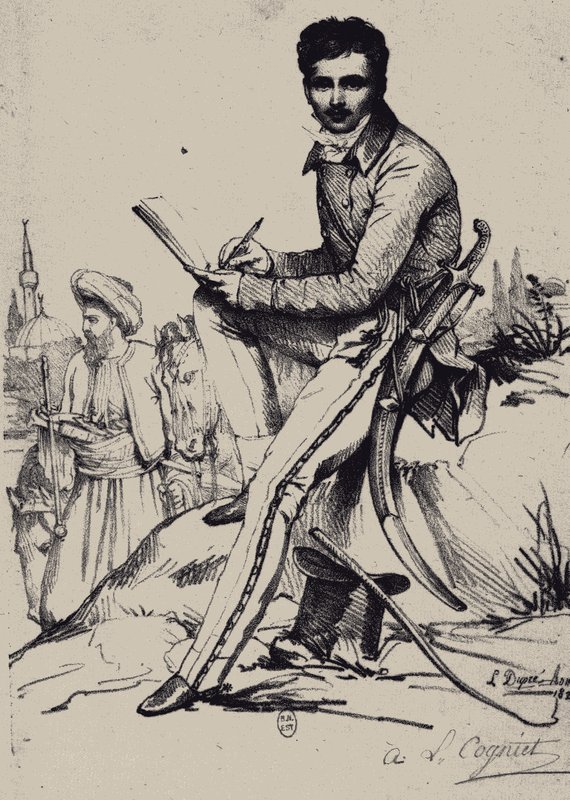
Louis Dupré (1789–1837) was a French painter, lithographer, and travel writer whose Orientalist and Philhellene works captured the Ottoman Empire and Greece during a pivotal historical moment. Born in Versailles on January 9, 1789—the very year the French Revolution began—and dying in Paris on October 12, 1837, Dupré's brief career was marked by extensive travels and the production of influential visual documentation of the Eastern Mediterranean world. As a student of Jacques-Louis David, the neoclassical master, Dupré received rigorous training in history painting, but his career took a distinctive turn when he traveled to Greece and Turkey in 1819-1820, experiences that produced his masterwork: "Voyage à Athènes et à Constantinople" (1825), an album of 40 hand-colored lithographs with accompanying text that became one of the most important visual records of Greek and Ottoman society on the eve of the Greek War of Independence. His contributions to Orientalist art earned him exhibition success at the Paris Salon (1817–1837) including a gold medal in 1824, establishing him among the significant French painters documenting the East during the height of European Philhellenism.
Louis Dupré was born in Versailles on January 9, 1789, as revolutionary fervor was transforming France. His birth year—1789—would forever link him to the French Revolution's promise and turmoil.
Dupré studied under Jacques-Louis David (1748–1825), the preeminent French neoclassical painter whose works including "The Oath of the Horatii" and "The Death of Marat" had helped define revolutionary aesthetics. David's rigorous training emphasized precise drawing, classical composition, and heroic subject matter drawn from ancient history and contemporary events.
As a history painter under David's tutelage, Dupré learned to create large-scale narrative compositions with careful attention to historical accuracy in costume and setting—skills that would prove valuable for his later Orientalist and travel works.
Dupré worked as a painter for Jérôme Bonaparte, Napoleon's youngest brother who ruled as King of Westphalia (1807–1813). This court position provided income and prestigious commissions while exposing Dupré to the grandeur and international ambitions of Napoleonic Europe.
Dupré's career involved extensive travel across Europe. He worked in Kassel (1811–1814) during Jérôme Bonaparte's reign as King of Westphalia, then moved to Naples (1814–1816) following Napoleon's fall.
From 1816 to 1819, Dupré worked in Rome, the essential destination for ambitious history painters. Rome offered direct study of classical antiquity and Renaissance masters while providing connections to international artistic communities and wealthy patrons on the Grand Tour.
During 1819–1820, Dupré worked again in Naples, but the most significant event came in February 1819 when he met three British art lovers: Heyet, Hay, and Vivian. They suggested that he accompany them on their journey to Greece, an invitation that would transform his career.
In February 1819, Dupré embarked on his pivotal six-month tour of Greece and Turkey with his British companions. This journey, lasting until April 1820, completely met Dupré's expectations and provided the material for his most significant artistic achievement.
Greece in 1819-1820 remained under Ottoman rule, but Greek nationalism was rising, and within a year the Greek War of Independence would begin (1821). Dupré's visit therefore documented Greek and Ottoman society at a crucial historical moment, just before revolutionary transformation.
During his travels, Dupré created numerous drawings and descriptions documenting the people from different levels of society, costume, architecture, and daily life. His artistic training allowed him to capture these subjects with both aesthetic appeal and ethnographic precision.
The journey took Dupré through Greece to Constantinople (Istanbul), exposing him to the full range of Ottoman Greek and Turkish society. His observations combined the painter's eye for visual drama with the travel writer's interest in cultural documentation.
Returning to Paris in 1820, Dupré worked to transform his travel material into publishable form. In 1825, he published "Voyage à Athènes et à Constantinople," which contained 40 colored lithographs and 11 vignettes accompanied by 52 pages of text.
The publication featured hand-colored lithographs depicting various figures from Greek and Ottoman society—portraits, views, and costume illustrations that documented the Eastern Mediterranean world just before the Greek War of Independence transformed it. These images served both aesthetic and documentary functions, appealing to European Philhellene sentiment while providing valuable ethnographic records.
From 1817 to 1837, Dupré exhibited regularly at the Paris Salon, the official annual exhibition that remained central to French artistic careers. His Orientalist and Philhellene themes found receptive audiences during the height of European enthusiasm for Greek independence and fascination with the East.
In 1824, Dupré won a gold medal at the Salon, confirming his achievement and elevating his status within the French art establishment. This recognition came at the peak of Philhellenism, when Byron's death at Missolonghi (1824) had intensified European support for Greek independence.
Dupré continued working in various European cities including Vienna (1820–1824) and Rome again (1824–1831), maintaining international connections while exhibiting regularly in Paris. His final Paris residence lasted from 1820 to 1837.
Louis Dupré died on October 12, 1837, in Paris, at just forty-eight years old. His premature death cut short a career that had made significant contributions to Orientalist art and visual documentation of the Ottoman world during a transformative period.
Artheon Research Team
Last updated: 2025-11-09
Biography length: ~1,180 words
Wikidata/Wikimedia Commons
All 2 artworks loaded