
Ctrl K
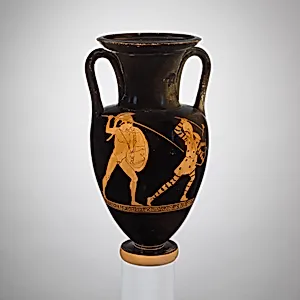
**The Dwarf Painter** was an anonymous Athenian red-figure vase-painter active in the Classical period, roughly 440–430 BCE. His conventional name, bestowed by the great scholar Sir John Beazley, derives from the distinctive figure of a dwarf that appears on one of the vases attributed to his hand. Working in the Attic tradition of fine pottery decoration, he specialized in the red-figure technique, in which figures were reserved in the natural red clay against a glossy black background, allowing for greater detail and expressiveness than the earlier black-figure method.
Little is known of his personal life or formal training, but stylistic analysis places him firmly within the orbit of the Achilles Painter, one of the leading masters of the mid-fifth century. Beazley described him as a follower “close to” the Achilles Painter, suggesting he may have trained or worked in the same workshop milieu. His compositions share the Achilles Painter’s refined drawing, balanced proportions, and interest in mythological or everyday scenes rendered with quiet dignity.
Among the works securely attributed to him is a small Nolan neck-amphora now in the Metropolitan Museum of Art (ca. 440–430 BCE). One side shows a Greek warrior in combat with an Amazon; the reverse depicts a standing man leaning on a staff. The vessel’s modest scale and elegant figural style are typical of the Dwarf Painter’s output. Other neck-amphorae and smaller vessels in collections such as the British Museum have been assigned to him on the basis of comparable drapery folds, facial types, and compositional rhythms.
Although his career was brief and his surviving oeuvre modest, the Dwarf Painter’s recognition by Beazley and subsequent scholars underscores the richness of the Attic red-figure tradition. His vases continue to illuminate the artistic networks of Classical Athens and the subtle variations that distinguish individual hands within the larger workshops of the period.