
Ctrl K
1689–1789
Ebenezer Cocker (1689–1789) was a British silversmith whose career spanned much of the 18th century, though details of his early life remain not well documented. Active from around 1739, primarily in London, Cocker contributed to the flourishing tradition of Georgian silverwork, crafting functional yet elegantly proportioned objects that exemplified the period's refined craftsmanship. His training and mentors are unrecorded in surviving sources, but his output aligns with the high standards of London-trained silversmiths, who often apprenticed under established masters in the Worshipful Company of Goldsmiths.
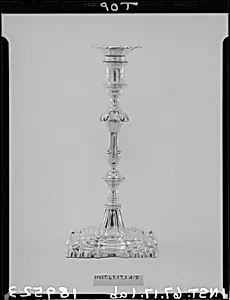
Cocker's style reflects the neoclassical influences emerging in mid-18th-century Britain, with clean lines, balanced forms, and subtle embellishments suited to domestic luxury. Among his known works are a pair of silver marrow scoops dated 1749, prized for their practical ingenuity and smooth, ergonomic design. More prominently, he produced silver candlesticks around 1764–66, now in the collection of the Metropolitan Museum of Art; these stand at 10 3/8 inches tall, featuring sturdy bases and tapering stems that evoke the era's taste for understated opulence. A set of four George III candlesticks by Cocker from 1762 appeared in recent auctions, highlighting ongoing collector interest. These pieces demonstrate his skill in hallmarks and maker's marks, ensuring authenticity in an age of booming silver trade.
Though Cocker's oeuvre is modest in documented scope, his surviving silver objects endure in major institutions, underscoring his role in Britain's decorative arts legacy. Living to the remarkable age of 100, he bridged the rococo flourishes of early Georgian design and the emerging restraint of later neoclassicism, offering modern viewers tangible links to 18th-century domestic life. His work invites appreciation of silversmithing as an art form, where utility meets artistry in enduring metal.