
Ctrl K
1829–1894
Ebenezer Newman Downard (1829–1894) was a British genre and landscape painter, etcher, and illustrator born in Brighton, Sussex, to Henry Downard, a bootmaker, and Charlotte Gower. Growing up in a modest household with several siblings, he attended Middle Street Primary School in Brighton from 1835 to 1840. His early artistic training is not extensively documented, though local records note he later became a student at the Royal Academy, launching a prolific career by exhibiting there as early as 1849—a span that continued until 1889, alongside shows at the British Institution and other venues. He even painted a portrait of Brighton's first mayor, Lieutenant-Colonel John Fawcett. In 1854, Downard married Ellen Jordan; the couple had two daughters, Ellen Charlotte (b. 1858) and Mary J. (b. 1860), and resided in London areas like Kensington and Hammersmith.
Downard's style is characterized by meticulous detail, clear bright light, and a keen eye for everyday narrative, blending genre scenes of rustic life with evocative landscapes. His landscapes, particularly later ones, reveal Pre-Raphaelite influences in their precision and luminous quality. Notable works include the oil painting *A Mountain Path at Capel Curig, Wales* (1860, Tate Britain), capturing Welsh scenery with crisp naturalism; *Morning Prayer* (1860–61), a tender domestic genre scene; *Reading the News* (oil on canvas, Brighton Museum & Art Gallery); and etchings like *Romeo and Juliet* (1883)._-_Reading_the_News_-_FA000662_-_Brighton_Museum_%5E_Art_Gallery.jpg) Others, such as *Cheap Jack at a Country Fair*, *Gossips*, and *Gulliver Diverting the Emperor of Lilliput* (Royal Academy, 1852), showcase his versatility in storytelling and whimsy.
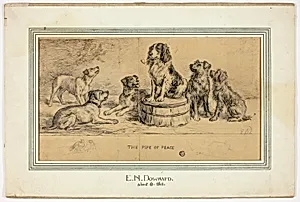
Though not a household name, Downard's legacy endures through pieces in prestigious collections like Tate Britain, the Art Institute of Chicago (*The Pipe of Peace*, pen and ink), and Brighton Museum, as well as steady auction interest. His four-decade Royal Academy presence underscores a steadfast commitment to Victorian genre traditions, offering viewers intimate glimpses of 19th-century British life rendered with enduring clarity and charm. He died in Westham, Sussex, in 1894 and was buried at St. Mary the Virgin Churchyard.
All 1 artworks loaded