Ctrl K
1865–1902
Occupations
Otto Eckmann (1865–1902) was a German painter and graphic designer who became one of the most influential figures in the Jugendstil (German Art Nouveau) movement. Born in Hamburg, Eckmann initially trained as a painter but made the radical decision in 1894 to abandon painting entirely, auctioning off his works to focus exclusively on applied design. This transition proved extraordinarily fruitful: he created the celebrated Eckmann typeface based on Japanese calligraphy and medieval fonts, designed covers for major German publishers, and produced influential graphic work for the magazines Pan and Jugend. His distinctive motifs—particularly swans and stylized women—became emblematic of the entire Jugendstil movement. Tragically, tuberculosis claimed his life at just thirty-six, cutting short one of the most promising careers in early modern German design.
Born on November 19, 1865, in Hamburg, Otto Eckmann showed early artistic inclinations. He pursued formal training at the Kunstgewerbeschule (School of Arts and Crafts) in Hamburg and Nuremberg, receiving instruction in both fine and applied arts.
He continued his education at the academy in Munich, then the center of German artistic life. During this period, Eckmann worked primarily as a painter, creating works in the academic and naturalistic styles that dominated German art schools in the 1880s.
However, by the early 1890s, Eckmann had become dissatisfied with conventional painting. Influenced by the emerging Art Nouveau movement and the British Arts and Crafts philosophy that elevated decorative arts to equal status with fine arts, he made a momentous decision in 1894: he would give up painting entirely and dedicate himself to applied design. To mark this transformation, he auctioned off his existing paintings, making a clean break with his previous career.
Eckmann's transition to applied arts proved brilliantly successful. In 1895, he began producing graphic work for Pan, an influential art magazine, and in 1896 for Jugend (Youth), the magazine that gave the German Art Nouveau movement its name. Jugend reached approximately 20,000 readers weekly, giving Eckmann's work wide visibility and influence.
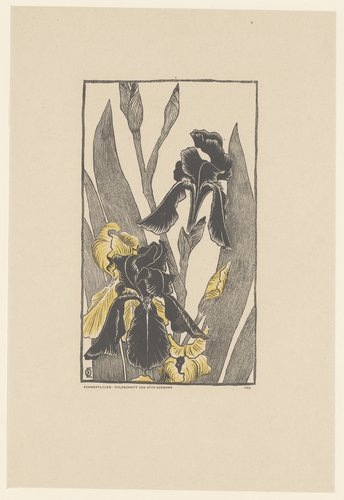
His designs for these magazines established the visual vocabulary of Jugendstil. He developed a distinctive style characterized by flowing, organic lines, floral motifs, and a particular fondness for depicting swans. While Art Nouveau generally favored female figures, Eckmann's personal obsession with swans became so influential that the bird became a symbol of the entire Jugendstil movement.
Eckmann created the Eckmann typeface, a revolutionary font based on Japanese calligraphy and medieval letter forms. This typeface embodied Jugendstil principles: combining historical sources with exotic influences to create something entirely modern. The font achieved wide circulation and remains associated with the period.
He also designed book covers for major German publishers including Cotta, Diederichs, Scherl, and Seemann, as well as creating the logo for the prestigious publishing house S. Fischer Verlag. These commissions demonstrated how Jugendstil penetrated commercial culture, making avant-garde design available to a broad public.
From 1900 to 1902, Eckmann expanded into industrial design, creating graphic work for the Allgemeine Elektrizitätsgesellschaft (AEG), one of Germany's largest electrical companies. This collaboration anticipated the later development of corporate identity and demonstrated Jugendstil's applicability to modern industry.
However, Eckmann had long suffered from tuberculosis, the disease that claimed so many lives in the 19th and early 20th centuries. Despite his illness, he maintained an extraordinarily productive output, creating designs that would influence German visual culture for decades.
Otto Eckmann died of tuberculosis on June 11, 1902, in Badenweiler, a spa town in the Black Forest, at just thirty-six years old. His death robbed German design of one of its most innovative voices just as Jugendstil was reaching its peak influence.
Artheon Research Team
Last updated: 2025-11-09
Biography length: ~486 words
Wikidata (CC0); Getty ULAN (ODC-By)
All 3 artworks loaded