Ctrl K

1832–1883
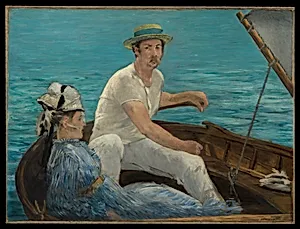
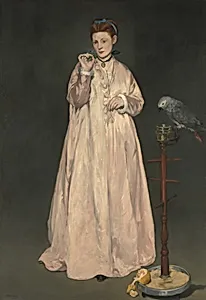
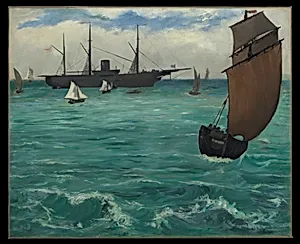
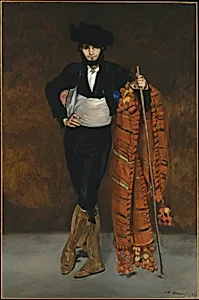
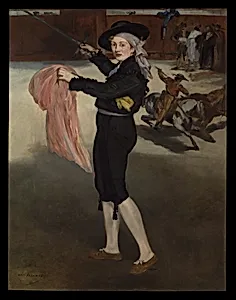
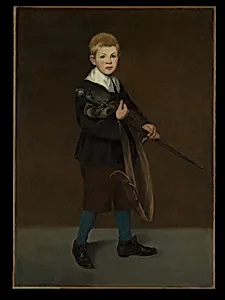
Édouard Manet (1832-1883) was a French painter who played a pivotal role in the transition from Realism to Impressionism, often called the 'Father of Modern Art.' Born into a wealthy Parisian family, Manet defied his father's wishes for a legal career to pursue painting, studying under academic artist Thomas Couture. His revolutionary works 'Le Déjeuner sur l'herbe' and 'Olympia' (both 1863) scandalized the art establishment with their bold rejection of academic conventions, flat modeling, and provocative contemporary subjects. Though he inspired the Impressionists and befriended Monet, Degas, and Morisot, Manet never exhibited with them, preferring to seek official recognition at the Salon. His innovative approach to color, light, and modern urban subjects laid the foundation for modernism.
Born January 23, 1832, in Paris to an affluent family—his father a judge, his mother the goddaughter of Swedish crown prince Charles Bernadotte. Despite family expectations of a legal career, young Édouard showed early talent for drawing and caricature.
After twice failing naval entrance exams, he enrolled in 1850 at the studio of Thomas Couture, where he studied for six years while developing an independent style influenced by Old Masters, particularly Velázquez, Goya, and Hals, whom he studied during travels to Italy, Germany, and the Netherlands.
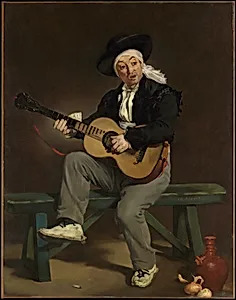
Manet's 'The Absinthe Drinker' (1859) was rejected by the Salon, but 'The Spanish Singer' (1860) earned an honorable mention, launching his career. He established a studio and began developing his distinctive style combining Old Master techniques with contemporary subjects.
In 1863, 'Le Déjeuner sur l'herbe' caused a sensation at the Salon des Refusés with its depiction of a nude woman casually picnicking with clothed men. The following year, 'Olympia'—a nude courtesan gazing boldly at the viewer—created even greater outrage, though both works were championed by young avant-garde artists.
Manet became the central figure of the 'Batignolles group,' gathering at the Café Guerbois with future Impressionists including Monet, Degas, Renoir, Pissarro, and Berthe Morisot. His café scenes and urban subjects established the vocabulary of modern life painting.
During the Franco-Prussian War and Paris Commune (1870-71), Manet served in the National Guard. His subsequent work showed increasing Impressionist influence, with lighter colors and outdoor scenes, though he retained his characteristic bold brushwork and use of black.
Though urged by his friends, Manet refused to exhibit with the Impressionists, continuing to pursue official Salon recognition. His painting style evolved toward greater luminosity, culminating in masterworks like 'A Bar at the Folies-Bergère' (1882), a complex meditation on modern Parisian life.
In 1881, Manet received the Legion of Honor, gaining the official recognition he had long sought. However, his health had been declining due to syphilis and locomotor ataxia. He died on April 30, 1883, eleven days after the amputation of his gangrenous left foot, at age 51.
Biography length: ~920 words