
Ctrl K
1822–1858
**Edward Sheffield Bartholomew** (c. 1822–1858) was an American neoclassical sculptor whose career, though brief, placed him among the leading figures of 19th-century American sculpture in Rome. Born in Colchester, Connecticut, he initially pursued practical trades, apprenticing as a bookbinder and dentist before working as a dentist in Hartford. Drawn to art, he discovered he was color-blind and turned to sculpture.
His formal training began in 1844 at the National Academy of Design in New York City, where he studied in the antique class. From 1845 to 1848 he served as director (or “curator-custodian”) of the Wadsworth Atheneum in Hartford, managing its collections and operations while continuing his artistic development. A severe bout of smallpox around 1847 interrupted his progress, yet he returned to the National Academy for further study before sailing for Europe. Settling in Rome in 1851, he remained there until his death from bronchitis in Naples on May 2, 1858.
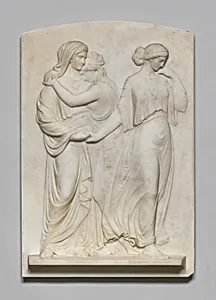
Bartholomew worked in the neoclassical tradition, producing sensitive bas-reliefs, marble busts, statues, and medallions. His earliest recorded work is a medallion of poet Lydia Sigourney (1847). Among his most celebrated pieces are *Blind Homer Led by the Genius of Poetry* (1851, Metropolitan Museum of Art), *Belisarius at the Pincian Gate* (1853), *Ruth, Orpah, and Naomi* (1855), *Hagar and Ishmael* (1856), *Campagna Shepherd Boy*, and *Eve Repentant*. Many of his sculptures reside in the Wadsworth Atheneum, reflecting his deep ties to Hartford.
Though he died young, Bartholomew’s elegant, classically inspired works helped shape the reputation of American sculptors abroad and continue to be admired for their technical refinement and emotional depth. His legacy endures in major museum collections and through the enduring appeal of his neoclassical vision.