Ctrl K
1794–1843
Elias Van Arsdale Coe, born on June 9, 1794, in Springfield Township, Union County, New Jersey, to Grover Coe and Mary Van Arsdale, emerged as a multifaceted figure in early 19th-century America. In his youth, he registered for military service in 1812 and relocated to New York City by the late 1810s, where he pursued entrepreneurial ventures. He sold damaged carpeting at bargain prices in 1816, advertised a variety of wares—including "very handsome" oil paintings—in 1817, and served as a registered auctioneer in partnerships like Harned, Barker & Coe through 1819. Little is documented about his formal artistic training, suggesting he was largely self-taught amid these commercial pursuits.
In 1821, Coe married Phebe Burt in Warwick, Orange County, New York, where the couple settled and raised their children, including son Dr. Grover Coe—who later succeeded him as a local physician—and daughters such as Mary Louise Coe Baldwin. There, he balanced medicine, portrait painting, and invention, registering as a physician and patenting an improved cream churn in 1831 based on "scientific and philosophical principles." Active as a painter primarily in the 1820s through 1830s, Coe focused on local commissions in Warwick, capturing residents, friends, and relatives, often in detailed domestic interiors without advertising his services.
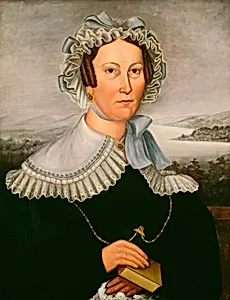
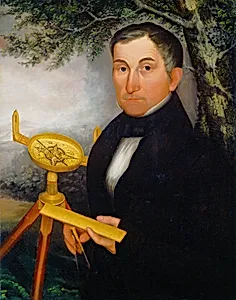
Coe's folk portraiture style exemplifies naive American art, characterized by simplicity, heartfelt directness, and meticulous accessories—like blazing hearths, floating apples, and stenciled chairs—that evoke everyday life. Among his notable works are the paired portraits of Henry W. Houston, aged 46, and Mrs. Phebe Houston, aged 39 (both 1837, oil on canvas, National Gallery of Art); posthumous depictions of Christopher Henry Spingler (1831) and his wife Mary Bonsall Spingler (ca. 1831, New-York Historical Society); and Portrait of Michael Murray van Beuren (1829). He also painted local physician Dr. James Young and likely family members like brother-in-law Nathaniel Jones.
Coe died suddenly on October 11, 1843, in Warwick at age 49, leaving a legacy as one of several physician-folk artists akin to Jacob Maentel or Rufus Hathaway. His paintings, preserved in prestigious institutions like the National Gallery of Art and New-York Historical Society, offer vivid glimpses into rural New York life, celebrated in local exhibits and histories for their unpretentious charm and historical insight.
All 2 artworks loaded