Ctrl K
1855–1940
**Ellen Day Hale** (1855–1940) was an American Impressionist painter and printmaker whose career exemplified the determination of women artists in the late nineteenth and early twentieth centuries. Born in Worcester, Massachusetts, into a prominent Boston Brahmin family, she was the daughter of author and orator Edward Everett Hale. Her extended family included notable figures such as great-aunt Harriet Beecher Stowe and other reformers, providing a network of strong female role models. Her brother Philip Leslie Hale and his wife Lilian Westcott Hale were also professional painters.
Hale began her formal training in Boston in 1873 with William Rimmer, focusing on drawing and anatomy, and later studied at William Morris Hunt’s school under Helen M. Knowlton. She attended the Pennsylvania Academy of the Fine Arts, where Thomas Eakins’s emphasis on the human figure influenced her. Seeking further instruction, she traveled to Europe and trained at the Académie Colarossi and, most significantly, the Académie Julian in Paris (1882 and 1885), studying with instructors including Tony Robert-Fleury, Jules Joseph Lefebvre, and William-Adolphe Bouguereau. There she learned etching from fellow artist Gabrielle de Veaux Clements, who became her lifelong companion in a relationship often described as a “Boston marriage.”
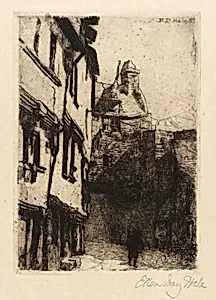
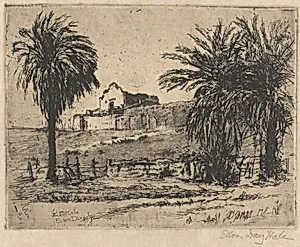
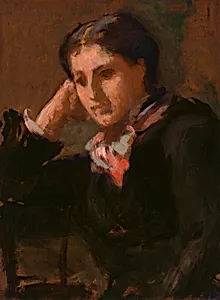
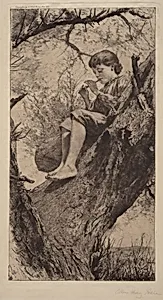
Hale worked primarily in the Impressionist manner associated with the Boston School, excelling in figure studies, portraits, and self-portraits while also creating landscapes and etchings. Her major works include the confident *Self-Portrait* (1885, Museum of Fine Arts, Boston), exhibited at the Paris Salon, and *June* (ca. 1893, National Museum of Women in the Arts), a luminous interior scene of a woman sewing. She exhibited widely—at the Boston Art Club, Royal Academy of Arts in London, and the 1893 World’s Columbian Exposition—and continued painting and teaching into her eighties.
Hale’s legacy lies in her pioneering independence and mentorship of younger New England women artists. She authored *History of Art*, wintered in Charleston where she helped found the Charleston Etchers’ Club, and lived a peripatetic yet productive life across Paris, London, Boston, and Washington, D.C. Her forthright self-representations and technical skill helped pave the way for greater acceptance of professional female artists.