Ctrl K
1861–1929
**Antoine Bourdelle** (born Émile Antoine Bordelles, 1861–1929) was a pivotal French sculptor whose work bridged the Beaux-Arts tradition and the emergence of modern sculpture, particularly influencing the Art Deco movement. Born in Montauban to a cabinetmaker father, he left school at thirteen to work in the family workshop before pursuing formal training. He studied at the École des Beaux-Arts in Toulouse and later moved to Paris, where he worked in the studios of Alexandre Falguière and frequented that of Jules Dalou. In 1893 he entered the studio of Auguste Rodin, remaining there for fifteen years and absorbing the master’s rugged realism while gradually developing his own voice.
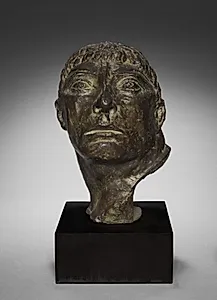
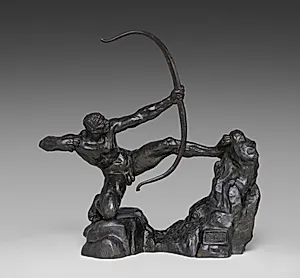
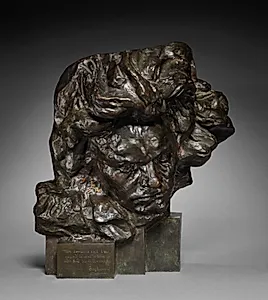
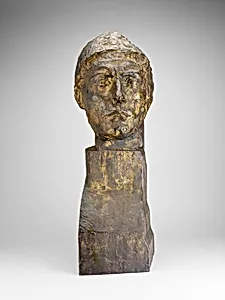
Bourdelle’s style evolved from Rodin-inspired vigor toward a synthesis of exaggerated, rippling surfaces with the flat, decorative planes of Archaic Greek and Romanesque art, infusing early 20th-century sculpture with renewed strength and monumentality. He achieved independence around 1900 with works such as the *Head of Apollo* and gained acclaim with *Hercules the Archer* (1909), a dynamic figure that drew on classical sources yet featured sinuous, muscular energy. Other notable pieces include the *Dying Centaur* (1914), reliefs for the Théâtre des Champs-Élysées (1910–12) that helped launch Art Deco aesthetics, the Montauban war memorial (completed 1902), and a series of Beethoven-inspired sculptures. His majestic public monuments, such as the Monument to Adam Mickiewicz (inaugurated 1929), cemented his reputation for powerful civic sculpture.
A dedicated teacher from 1909 until his death, Bourdelle instructed hundreds of students at the Académie de la Grande-Chaumière, including Alberto Giacometti and Henri Matisse. His Paris studio and garden were preserved after his death in Le Vésinet on 1 October 1929 and opened as the Musée Bourdelle in 1949; a second museum exists in Égreville. Bourdelle’s legacy endures through his innovative fusion of tradition and modernity, his influence on generations of sculptors, and the widespread presence of his works in major collections worldwide. His second wife, Cléopâtre Sevastos, and daughter Rhodia also played roles in preserving and promoting his oeuvre.