
Ctrl K
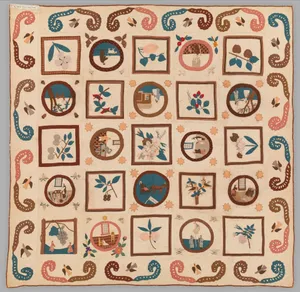
Emma Civey Stahl, born around 1860 in Iowa or Illinois, emerged as a remarkable young talent in American textile art during the post-Civil War era. Little is known of her early training or formal education, as her life remains sparsely documented beyond her singular surviving masterpiece, but by age 15, she had crafted the extraordinary *Woman’s Rights Quilt* around 1875. Produced in Illinois using cotton appliqué and piecing, this 70 × 69½-inch pictorial quilt weaves together vignettes of Civil War sacrifice and the burgeoning women's rights movement, reflecting the turbulent social currents of Reconstruction America.
The quilt's twelve blocks burst with narrative vitality, blending realistic human figures, animals, and flora in a folk art style that prioritizes storytelling over ornamentation. Circular medallions depict Union soldiers departing for battle— one bearded figure in faded blue uniform bidding farewell to his aproned wife—while others show their return amid flags and angels, evoking personal loss and national triumph. Parallel scenes satirize suffrage activism: a bespectacled woman brandishing a "WOMAN’S RIGHTS" banner abandons her struggling husband and child for a rally; another lectures a cowering audience from a podium, her aggressive stance injecting wry humor into the era's heated debates. Floral borders in muted neutrals frame these dynamic episodes, underscoring Stahl's skill in balancing whimsy, critique, and everyday domesticity.
Stahl's personal life intersected with her art's themes; she married Jacob Shelden Stahl, an Ohio-born laborer, and raised children including daughter Marion Stahl Gabriel and son Joseph Augustus, born in Pleasant Valley, Iowa, in 1880. The quilt descended through Marion to subsequent owners before entering The Metropolitan Museum of Art in 2011 via donor funds, where it has anchored discussions on women's ambivalence toward suffrage and the power of quilts as historical documents. Today, Stahl's work endures as a testament to self-taught ingenuity, illuminating mid-19th-century American women's complex inner worlds through thread and cloth, and securing her place in the canon of overlooked fiber artists.