Ctrl K
1730–1782
Ernst Gottlob Borns (1730–1782) was a German silversmith based in Bautzen, Saxony, renowned for his elegant silver vessels and domestic objects produced during the mid-eighteenth century. Early life details remain sparsely recorded, with no documented information on his training or mentors. He established his workshop in Bautzen, a city east of Dresden, where he created pieces marked with his name and active primarily from the 1750s through the 1770s.
Borns worked firmly within the German Rococo tradition, adapting the style’s characteristic exuberance and asymmetry to functional silver forms. His designs often featured waisted or barrel-shaped bodies, elaborate chased ornament, and a distinctive Saxon flair that blended French-inspired curves with robust local execution. The superb technique and flamboyance of his work exemplify the Rococo’s playful yet refined aesthetic in silver.
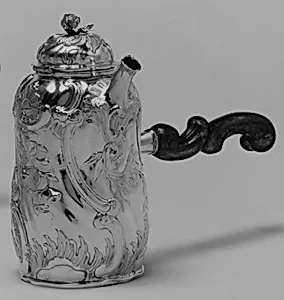
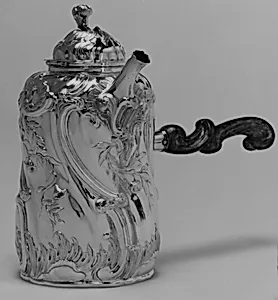
Among his documented pieces are a silver coffeepot dated circa 1765–70, now in the Metropolitan Museum of Art, featuring a wooden handle and intricate detailing, and a chamber candlestick from around 1760 offered at auction. Additional surviving works include a parcel-gilded ladle marked by Borns, circa 1760. These objects highlight his skill in both utilitarian and decorative silver.
Though biographical records are limited, Borns’s surviving silverware continues to be valued by collectors and institutions for its technical mastery and regional Rococo character, preserving a vivid record of eighteenth-century Saxon craftsmanship. His two known works in the virtual museum collection underscore his contribution to the decorative arts of his era.
All 2 artworks loaded