
Ctrl K
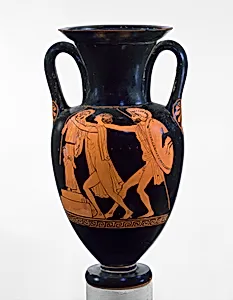
**The Ethiop Painter** was an anonymous Athenian red-figure vase painter active in Attica around 450 BCE during the Classical period. His conventional name, assigned by the scholar J.D. Beazley, derives from a distinctive depiction of a black Ethiopian servant of the mythical Egyptian king Busiris on one of his vases. Like many ancient Greek artisans, his personal identity remains unknown, yet consistent stylistic traits across surviving works confirm him as a distinct artistic personality.
He specialized in decorating small-scale vessels, particularly Nolan neck-amphorae and pelikai, employing the red-figure technique that allowed for greater detail and naturalism in figures compared to earlier black-figure methods. His compositions often featured mythological or everyday scenes rendered with careful attention to pose and drapery. Notable attributed pieces include a terracotta Nolan neck-amphora in the Metropolitan Museum of Art (ca. 450 BCE), showing the Greek hero Ajax on one side, and several pelikai excavated at Nola now in the British Museum.
Early life details are not well documented, and no teachers or mentors are recorded in surviving sources. The painter worked within the broader tradition of Attic red-figure pottery, contributing to the vibrant ceramic industry centered in Athens that supplied markets across the Mediterranean.
Though his output was modest in scale, the Ethiop Painter’s vases exemplify the refined draftsmanship of mid-fifth-century Attic workshops. His attributions, based on Beazley’s stylistic analysis, continue to aid scholars in understanding the diversity of painters active alongside more famous figures of the period. A handful of his works survive in major museum collections, preserving glimpses of both mythological narratives and the artistic conventions of Classical Greece.