Ctrl K
1460–1522
Ezra (ca. 1460–1522) was a master craftsman from Ethiopia's northern Highlands, particularly the Tigray region near the Red Sea, the cradle of the country's ancient Christian kingdom. A member of the esteemed Stephanite monastic order, renowned for producing the finest carved crosses and illuminated manuscripts, Ezra honed his skills during the order's exile in Egypt. There, he absorbed advanced techniques of inlay and marquetry from Coptic craftsmen, adapting them to create innovative works that blended local traditions with external influences from Mamluk metalwork. His early life remains sparsely documented, but his association with monasteries like Gunda Gunde underscores his deep immersion in Ethiopia's vibrant Orthodox Christian artistic milieu.
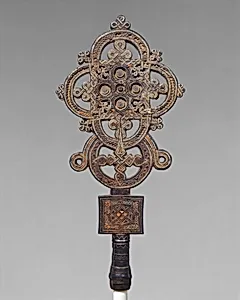
Working in the Tigrinya tradition, Ezra specialized in processional crosses (mäsqälot qǝddase), sacred objects believed to channel Christ's sanctifying power for healing and blessing during liturgical rites. His masterpiece, a ca. 1500 liturgical cross of carved wood inlaid with tin (now in The Metropolitan Museum of Art), exemplifies his genius: each elaborately distinct side features intricate foliate and organic interlace patterns evoking the Tree of Paradise, with the solid wooden structure pierced by shimmering metal for dramatic tonal contrasts—a tour de force unmatched in complexity. This rare pre-seventeenth-century survivor highlights his pioneering material interplay, bridging Ethiopian woodcarving with Egyptian marquetry.
Though primarily known for this iconic cross, Ezra's oeuvre includes at least 12 documented artworks in major collections, reflecting his contributions to the Stephanites' legacy as preeminent cross-carvers and manuscript illuminators. His innovations preserved amid a scant surviving corpus of early Ethiopian Christian art, Ezra's works testify to Red Sea cultural exchanges and the enduring spiritual potency of Tigrayan craftsmanship, influencing generations of monastic artists.