Ctrl K
Farrukh Chela stands as one of the most prolific miniaturists of the Mughal court during the reign of Emperor Akbar (r. 1556–1605), active from around 1580 or 1585 until at least 1604. Working in the vibrant imperial ateliers of Fatehpur Sikri and Agra, he contributed illustrations to nearly every major manuscript produced under Akbar's patronage, including epic histories and poetic romances that blended Persian, Indian, and European influences. Little is known of his early life or training, as biographical details from the period are sparse beyond his signed works, but his emergence aligns with Akbar's cultural renaissance, where artists from diverse backgrounds synthesized styles into the distinctive Mughal idiom.
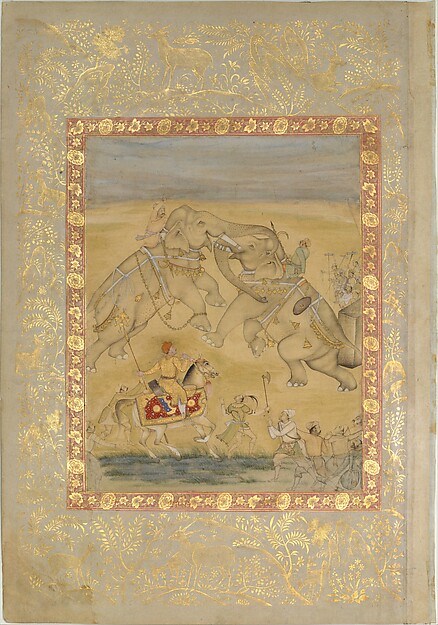
Chela's artistic style exemplifies the early Mughal miniature tradition: fine-line precision, vivid jewel-toned colors, and dynamic compositions that captured both narrative drama and naturalistic detail. He favored bold animal motifs and courtly scenes, often infusing his figures with a sense of movement and emotion drawn from indigenous Indian traditions while adhering to the refined Persianate aesthetics prized at court. His illustrations graced prestigious projects like the Akbarnama, the official biography of Akbar, and poetic cycles such as the Khamsa of Nizami.
Among his surviving masterpieces are *Shirin Receives a Ring from Khusraw* (1597–1598, Walters Art Museum, Baltimore), a tender romantic episode rendered with exquisite landscape details; *A Buffalo Fighting a Lioness* (Nelson-Atkins Museum of Art, Kansas City); *The Greedy Dog* (ca. 1575–1600, Art Institute of Chicago); and *The Punishment of Khwaja Mu'azzam* (1604, Chester Beatty Library, Dublin), from the illuminated Akbarnama, depicting a dramatic execution with unflinching realism. These works, scattered across collections like the Freer Gallery of Art and Cincinnati Art Museum, showcase his versatility in fable, battle, and history.
Farrukh Chela's legacy endures as a cornerstone of Mughal painting's golden age, influencing generations of atelier artists. His signed folios, preserved in world-class institutions, offer invaluable insight into Akbar's vision of a syncretic empire, where art bridged cultures and immortalized imperial grandeur. Though his later years fade from record, Chela's output—over two dozen identified attributions—cements his role as an unsung pillar of Indian miniature mastery.
Wikidata (CC0); Getty ULAN (ODC-By)