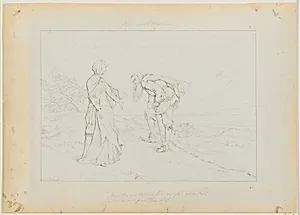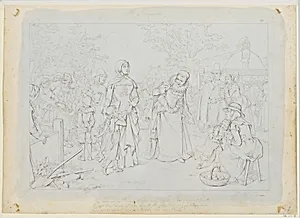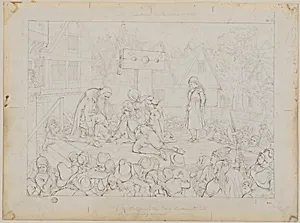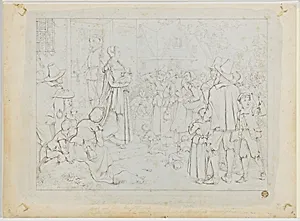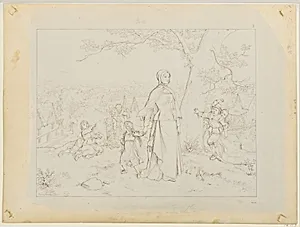
Felix Octavius Carr Darley, known professionally as F. O. C. Darley, was born on June 23, 1822, in Philadelphia, Pennsylvania, to English immigrant parents with a theatrical background—his mother a noted actress and his father a former actor who served as a Marine lieutenant. From an early age, Darley displayed a passion for drawing, sketching scenes from his surroundings despite his parents' encouragement toward a commercial path. At fourteen, he apprenticed as a clerk for the Philadelphia Dispatch Transportation Line, where he honed his skills through informal practice, producing caricatures and dockside vignettes that caught attention. Entirely self-taught, with no formal training or mentors documented, Darley transitioned into professional illustration as a staff artist for a Philadelphia publishing house, laying the foundation for his prolific career.
By the early 1840s, Darley relocated to New York City, becoming one of America's foremost illustrators amid a publishing boom fueled by rising literacy and new technologies. His distinctive style—characterized by bold, sweeping outline drawings devoid of shading, dramatic compositions, realistic expressions, and vigorous energy—influenced by German illustrator Moritz Retzsch, captured the American spirit with versatility across genres. He produced groundbreaking works such as illustrations for Edgar Allan Poe's "The Gold-Bug" (1843), the first fully illustrated edition of Washington Irving's "Rip Van Winkle" (1848), and "The Legend of Sleepy Hollow," alongside nearly 350 drawings for James Fenimore Cooper's novels in multi-volume editions (1859–1861). Darley also illuminated Nathaniel Hawthorne's "The Scarlet Letter" in *Compositions in Outline* (1879), vividly depicting scenes like the market place and the letter's revelation, as well as works by Charles Dickens, Harriet Beecher Stowe, and Henry Wadsworth Longfellow. Elected an honorary member of the National Academy of Design in 1851 and a full academician the following year, he married Jane Colburn in 1859.
In his later years, Darley traveled Europe, publishing *Sketches Abroad with Pen and Pencil* (1868), and created spirited watercolors of American history, including Civil War vignettes and bank-note designs. Settling in a Victorian mansion in Claymont, Delaware (now the historic Darley House), he remained extraordinarily productive until his death on March 27, 1888. Darley's legacy as the pioneer of American illustration endures; for nearly five decades, he was the most widely circulated illustrator in the U.S., establishing the profession's traditions, inspiring generations, and earning posthumous induction into the Society of Illustrators Hall of Fame in 2001. His work not only amplified literary narratives but democratized visual art for everyday Americans.
All 5 artworks loaded