Ctrl K
1881–1955
**Fernand Léger (1881–1955) was a French painter, sculptor, and filmmaker whose innovative work bridged Cubism and modern popular art.** Born Joseph Fernand Henri Léger on February 4, 1881, in Argentan, Normandy, he grew up in a family of cattle farmers. He initially trained as an architect’s apprentice in Caen from 1897 to 1899 before moving to Paris in 1900, where he worked as an architectural draftsman and photography retoucher to support himself.
Rejected by the École des Beaux-Arts, Léger studied painting as a non-enrolled student under the academic painter Jean-Léon Gérôme until 1904, also attending the Académie Julian. His early Impressionist-style works gave way to a dramatic shift after encountering the 1907 Paul Cézanne retrospective at the Salon d’Automne. By 1909, he had settled in Montparnasse at La Ruche, where he connected with avant-garde figures including Robert Delaunay, Alexander Archipenko, and writers like Guillaume Apollinaire.
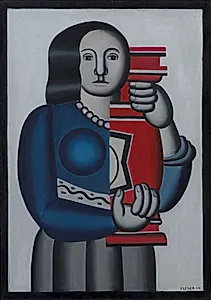
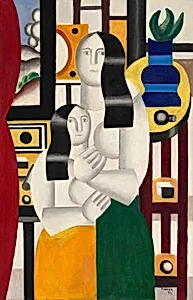
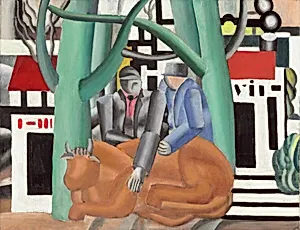
Léger developed a distinctive personal Cubism known as “tubism,” emphasizing cylindrical, tubular forms rendered in bold primary colors, black, and white. Key early works include *Nudes in the Forest* (1910) and *The Smokers* (1911–12). His World War I experiences, including time at the front and a near-fatal gas attack, inspired his “mechanical period,” seen in paintings like *The Card Players* (1917) and the iconic *The City* (1919). He later explored Purism, film (co-directing the experimental *Ballet Mécanique* in 1924), murals, and more figurative styles celebrating modern life and ordinary people.
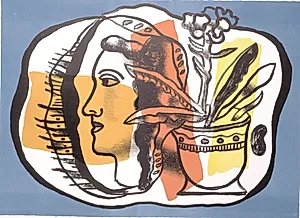
In his later decades, Léger produced monumental figure compositions, taught extensively (including at Yale during his 1940–1945 wartime stay in the United States), and created public works such as murals for the United Nations. He is celebrated as a forerunner of Pop Art for his embrace of machine-age imagery and consumer culture. His legacy endures through the Fernand Léger National Museum in Biot, France, and his influence on generations of artists exploring the intersection of abstraction, figuration, and everyday modernity.