
Ctrl K
1479–1544
Occupations
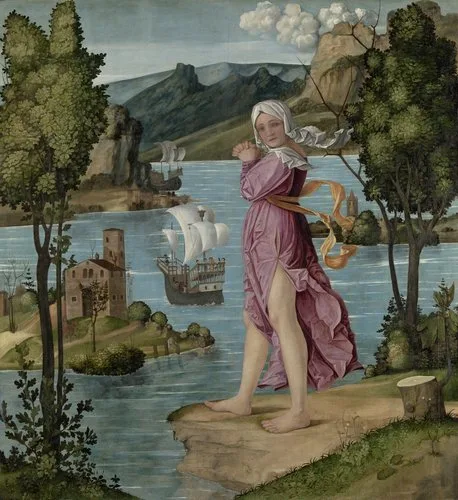
Filippo da Verona (c. 1479–1544), born in Verona to a father named Giovanni, was an Italian painter active primarily in the early 16th century. His early life and training remain not well documented, with no specific teachers or art schools recorded, though his style clearly drew from the Venetian Renaissance tradition, particularly recalling the serene compositions and luminous landscapes of Giambattista Cima da Conegliano, as well as influences from Vittore Carpaccio, Giovanni Bellini, and Alvise Vivarini.) By around 1509, he had established himself in Padua, contributing to the city's rich devotional art amid the Basilica of Saint Anthony and related institutions.
Filippo's documented career began with frescoes and altarpieces centered on sacred themes. In 1509, he painted *Virgin and Child with Saints Felix and Catherine* for the Basilica of Saint Anthony in Padua (now attributed), followed by his first securely dated work in 1510: the fresco *Saint Anthony Appears to the Blessed Luca Belludi*, in the Sala Capitolare of the Scuola del Santo, depicting the saint prophesying Padua's liberation from Ezzelino da Romano. The next year, 1511, saw *Glory of the Virgin with Angels and Saints* in the Church of the Eremitani. His style evolved by 1514, incorporating bolder colors and expressive forms akin to Giorgione and early Lorenzo Lotto in *Madonna and Child between Saints Peter and Nicholas of Bari* for San Niccolò in Fabriano (now in the Civic Museum). Other notable pieces include *Virgin and Child* in Turin's Academy of Arts and a lost series of 32 bishop portraits for Savona Cathedral in 1515.
Though a minor figure compared to his Venetian models, Filippo da Verona bridged Paduan devotional fresco cycles with altarpiece innovations, blending epigonal serenity with emerging anticlassical experimentalism from Lombard and Marchigian sources. His works, scattered in museums from Turin to Kansas, exemplify the diffusion of Renaissance ideals beyond major centers, influencing regional painters like Dosso Dossi through fused Venetian-Lombard syntax.) Today, his contributions endure in Padua's sacred spaces, offering glimpses into early Cinquecento piety and artistic mobility.
Wikidata (CC0); Getty ULAN (ODC-By)
