Ctrl K
1692–1767
Occupations
Jacob Folkema (1692–1767) was a Dutch engraver whose prolific output and technical excellence made him one of the most important printmakers in eighteenth-century Amsterdam. Born in Dokkum, Friesland, in 1692, Folkema first received instruction from his father, goldsmith Johann Jakob Folkema, before studying under Bernard Picart in Amsterdam, one of the period's most renowned engravers. This training equipped Folkema with both the precision required for reproductive engraving and the creative skills necessary for original compositions. Folkema's career encompassed major illustrated book projects, including Royaumont's Bible (1712) and Ruysch's Anatomy (1737), as well as independent prints and mezzotint engravings. His works are characterized by technical refinement and clarity of execution. With 509 prints by Folkema held in the Rijksmuseum Amsterdam alone, and works in collections including the Smithsonian, National Portrait Gallery, Metropolitan Museum, and Library of Congress, his production demonstrates both quantity and quality that secured his reputation as an excellent engraver in multiple techniques.
Jacob Folkema was born in Dokkum, Friesland, in 1692. His father, Johann Jakob Folkema, was a goldsmith who provided Jacob's first instruction, teaching him the precise handling of engraving tools and the attention to fine detail characteristic of goldsmith work.
Folkema subsequently moved to Amsterdam to study under Bernard Picart (1673–1733), one of the most celebrated engravers of the period. Under Picart's tutelage, Folkema learned sophisticated reproductive engraving techniques and the artistic principles necessary for translating paintings and drawings into prints.
This combination of goldsmith precision from his father and artistic training from Picart gave Folkema the technical foundation for his successful career.
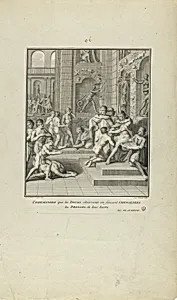
By 1712, Folkema was sufficiently established to work on major illustrated book projects. He contributed engravings to Royaumont's Bible in 1712, one of the important biblical illustration projects of the early eighteenth century.
In 1737, he created engravings for Ruysch's Anatomy, demonstrating his versatility and ability to handle both religious and scientific subjects with equal technical proficiency.
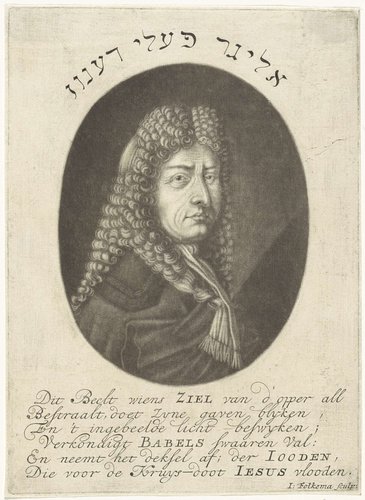
Folkema was not only an excellent line engraver but also skilled in mezzotint, a demanding technique that creates tonal effects through the careful manipulation of a roughened copper plate. This technical range allowed him to work across different genres and satisfy various patron demands.
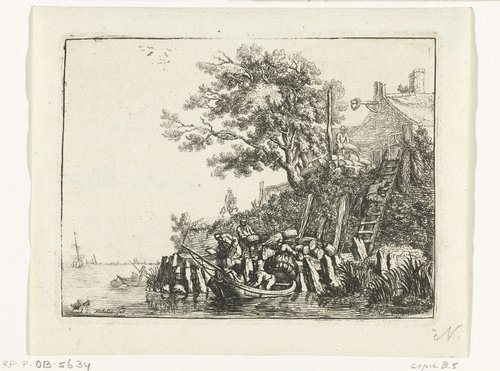
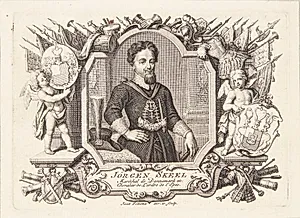
His independent prints included emblematical works, portraits, and reproductive engravings after Old Masters. Notable prints include 'An Emblematical Print on the Death of the Prince of Orange' and 'Time discovering the Bust of F. Rabelais,' as well as portraits like 'Jacqueline of Bavaria' (1753) and 'Charles de Solier, Sieur de Morette' (1750–1757).
Folkema had a sister, Anna Folkema, who painted miniatures and occasionally assisted her brother, engraving a few plates herself, suggesting the family maintained a collaborative artistic workshop.
Jacob Folkema died in Amsterdam in 1767 at age seventy-five, having established a substantial body of work that secured his reputation as one of the period's leading engravers.
Artheon Research Team
Last updated: 2025-11-09
Biography length: ~462 words
Wikidata (CC0); Getty ULAN (ODC-By)