Ctrl K
The artist known as a Follower of James McNeill Whistler was an unidentified American painter and draftsman active in the late 19th century. Early life and formal training are not well documented, as no biographical records of this individual have come to light. The works associated with this designation were created in close emulation of James McNeill Whistler, the American-born expatriate who pioneered Tonalism and championed the Aesthetic movement’s principle of “art for art’s sake.”
The follower’s surviving output consists of intimate drawings and watercolors that capture Whistler’s characteristic emphasis on atmospheric mood, subtle tonal harmonies, and simplified compositions. Subjects favored by the master—Venetian canals, French coastal views, and portrait studies—appear frequently, often accompanied by a butterfly monogram added by an unknown hand in imitation of Whistler’s famous signature. These pieces demonstrate a practiced understanding of Whistler’s techniques in crayon, charcoal, and watercolor, suggesting the artist was either a direct admirer or worked within the circle of his influence.
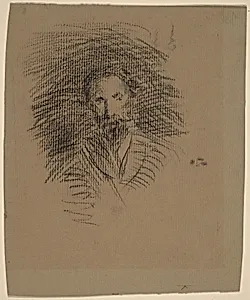
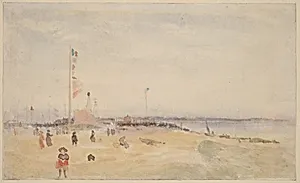
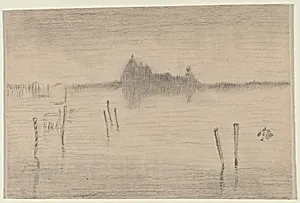
Three representative works from the late 19th century illustrate this affinity: a black-crayon drawing of Venice showing canals, architecture, and gondolas; a charcoal sketch identified as Charles L. Freer, the Detroit industrialist and major collector of Whistler’s art; and a watercolor-and-gouache view of Pourville-sur-Mer featuring a beach scene with flags and figures.
Though the creator remains anonymous, these modest yet evocative sheets reveal the breadth of Whistler’s impact on American artists of the Gilded Age. They stand as tangible evidence of how his innovations in color, composition, and the elevation of beauty over narrative were absorbed and reinterpreted, helping to disseminate Tonalism and Aesthetic ideals across the Atlantic. Today the works offer valuable insight into the popular reception of Whistler’s vision and the many unnamed hands that carried it forward.
All 3 artworks loaded