Ctrl K
1425–1478
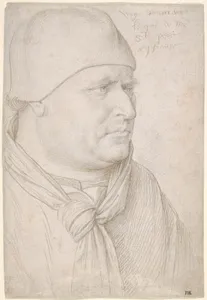
Jean Fouquet (c. 1420–c. 1481), born in Tours, stands as a pivotal figure in French art, excelling as both a panel painter and a miniaturist. Little is known of his early years, but he is regarded as having trained in the Parisian workshops associated with the Bedford Master before journeying to Italy around 1445–1447. There, as the first French artist to encounter the Italian Renaissance firsthand, he studied the works of Fra Angelico and others, even painting a portrait of Pope Eugene IV.
Returning to France, Fouquet forged a distinctive style that merged the spatial innovations and volumetric forms of Italian art with the meticulous detail and luminous quality of Flemish painting, all infused with a French sensibility. This approach established him as the founder of a significant new school. Appointed court painter, he created works for Charles VII and Louis XI, capturing the essence of the French court in the aftermath of the Hundred Years' War.
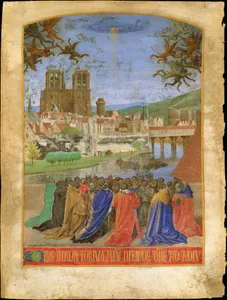
His masterpiece, the Melun Diptych of circa 1452–1458, features Étienne Chevalier presented by Saint Stephen on one panel and a striking Virgin and Child—portrayed with the features of the king's mistress Agnès Sorel—on the other. Fouquet's illuminations, such as those in the Hours of Étienne Chevalier and the Grandes Chroniques de France, demonstrate his unparalleled skill in miniature, while his portraits, including the iconic self-portrait enamel of 1450, mark him as the inventor of the portrait miniature.
Fouquet's enduring legacy is his synthesis of Northern and Italian traditions, paving the way for the French Renaissance. His precise observation, innovative compositions, and ability to infuse religious and historical scenes with contemporary portraits continue to captivate, securing his place as one of the 15th century's greatest artists.