Ctrl K
1732–1806
Movements
Occupations
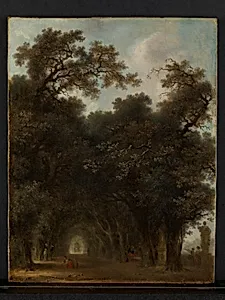
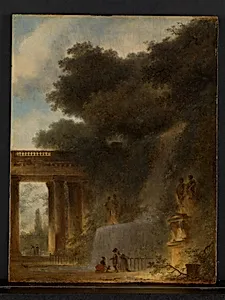
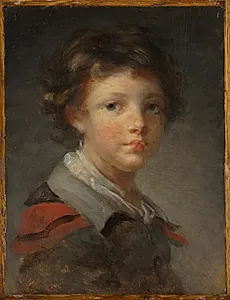
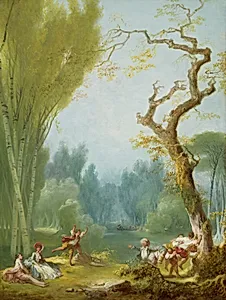
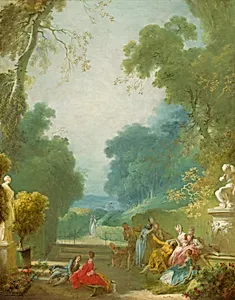
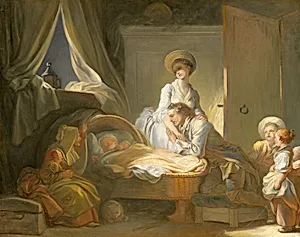
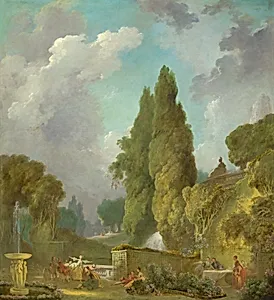
Jean-Honoré Fragonard (1732-1806) was a French painter and printmaker whose late Rococo manner was distinguished by remarkable facility, exuberance, and hedonism. Born in Grasse, he moved to Paris where he trained under Jean-Baptiste Chardin and François Boucher, winning the prestigious Prix de Rome in 1752. After studying in Italy alongside Hubert Robert, Fragonard returned to Paris in 1761 to find an eager market for his cabinet pictures. Though his 1765 painting 'Coresus and Callirhoë' brought critical acclaim and hopes he would revitalize history painting, he chose instead to work for private collectors, creating over 550 paintings of remarkable variety. His most famous work, 'The Swing' (1767-68), epitomizes the frivolity and sensuality of the Rococo era. One of the most prolific artists of the Ancien Régime, Fragonard combined technical virtuosity with subjects ranging from erotic courtly scenes to intimate family life. The French Revolution devastated his career as patrons were guillotined or exiled, and he died in relative obscurity in 1806. His expressive brushwork and confident handling of color profoundly influenced the Impressionists, particularly Berthe Morisot (his grand-niece) and Renoir.
Born on April 5, 1732, in Grasse, Alpes-Maritimes, France, as the only child of François Fragonard, a glover of northern Italian descent, and Françoise Petit. In 1738, the family relocated to Paris where young Jean-Honoré was initially enrolled as a clerk in a notary's office.
At age 18, Fragonard was taken to the renowned painter François Boucher, who recognized his potential but refused to teach him without basic training. Boucher sent him to study under Jean-Baptiste Chardin, where Fragonard learned fundamental techniques of mixing colors and forming shapes. After this brief but essential apprenticeship, he returned to Boucher's studio around 1749-1750, training there for two or three years.
Though not yet an Academy student, Fragonard's talent developed rapidly under Boucher's guidance. In 1752, at age 20, he won the prestigious Prix de Rome with his painting 'Jeroboam Sacrificing to Idols.' Before departing for Italy, he continued studying for three more years under Charles-André van Loo, further refining his skills and preparing for the transformative Italian experience ahead.
In December 1756, Fragonard took up residence at the French Academy in Rome, then presided over by Charles-Joseph Natoire. This Italian period proved crucial to his artistic development, exposing him to the masters of the Dutch and Flemish schools—Rubens, Hals, Rembrandt, and Ruisdael—whose loose and vigorous brushstrokes he admired and imitated.
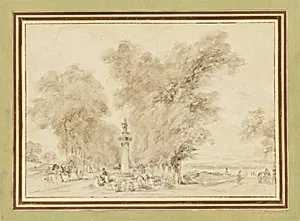
While in Rome, Fragonard formed a close friendship with fellow painter Hubert Robert. In 1760, the two toured Italy together, executing numerous sketches of local scenery. The florid sumptuousness of Giovanni Battista Tiepolo, whose works Fragonard studied in Venice, made a deep impression, adding another layer to his evolving style.
These Italian years allowed Fragonard to absorb diverse artistic influences and techniques that deeply enriched his painting style, combining the theatrical grandeur of Italian Baroque with the delicate sensibilities of French Rococo, creating a unique artistic voice that would define his mature work.
Returning to Paris in 1761, Fragonard found an eager market for his cabinet pictures. The spectacular critical success of 'Coresus and Callirhoë,' submitted to the Royal Academy in 1765, raised expectations that he would become the salvation of history painting in France. However, it was a promise he chose not to fulfill, abandoning the conventional career path dictated by the Academy's hierarchical structure.
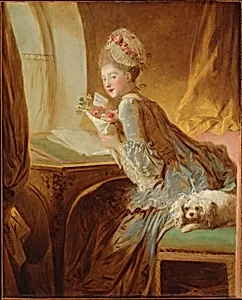
Instead, Fragonard worked largely for private patrons, neglecting royal commissions in favor of more lucrative and creatively satisfying work. Between 1767-1768, he painted his most famous work, 'The Swing' (also known as 'The Happy Accidents of the Swing'), commissioned by Baron Louis-Guillaume Baillet de Saint-Julien. This masterpiece epitomizes Rococo art with its frivolity, luxury, and indulgence, featuring pastel colors, fluid brushwork, and playful eroticism.
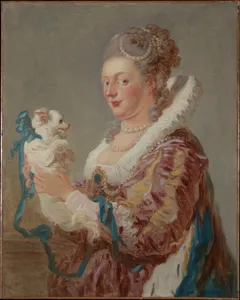
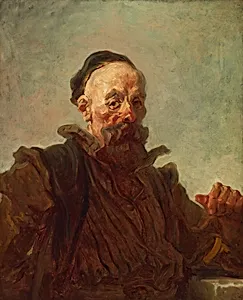
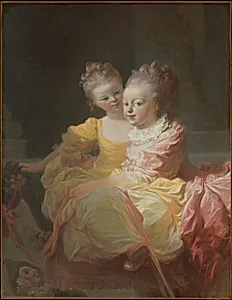
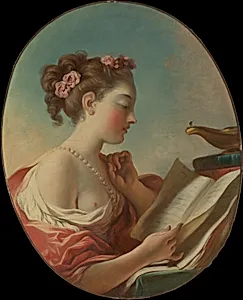
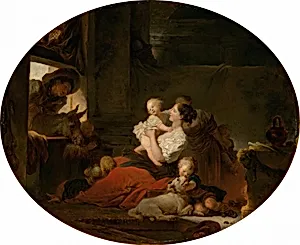
During this period, Fragonard created the Fantasy Figures series, pushing boundaries of accepted portrait painting with remarkable painterly skill. He married Marie-Anne Gérard, herself a miniature painter, on June 17, 1769. Their daughter Rosalie became one of his favorite models. In 1778, his wife's 14-year-old sister, Marguerite Gérard, became his student and assistant. His son Alexandre-Évariste, born in 1780, would eventually become a talented painter and sculptor.
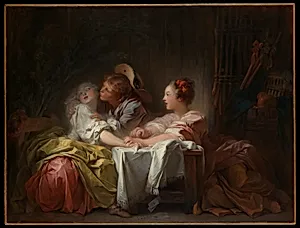
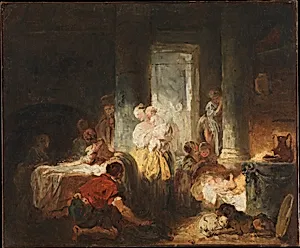
One of the most prolific artists of his era, Fragonard produced more than 550 paintings during four decades (not counting drawings and etchings), though only five are dated. His work constituted a further elaboration of the Rococo idiom established by Antoine Watteau and François Boucher, but with distinctive expressive qualities all his own.
The French Revolution devastated Fragonard's career and livelihood. His private patrons—the wealthy aristocrats who had sustained his success—were either guillotined or exiled. The hedonistic, frivolous subjects that had made him famous were suddenly out of favor in the new revolutionary climate that demanded austerity and civic virtue.
Fragonard fled Paris for his native Grasse during the Reign of Terror. In 1793, he returned to the capital where his old acquaintance Jacques-Louis David—now a powerful figure in revolutionary art circles—appointed him a curator at the new national museum. This administrative position at the Louvre provided some security, but his creative work had fallen from fashion.
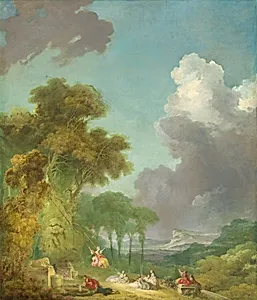
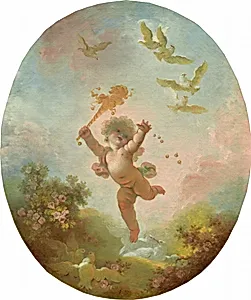
Certain of Fragonard's later paintings, like 'The Invocation to Love,' demonstrate a darker, more emotional character that anticipates Romanticism, suggesting he attempted to adapt to changing tastes. However, the vibrant, playful style that had defined his career could not be reconciled with the austere neoclassicism that dominated the revolutionary and Napoleonic periods.
Fragonard died on August 22, 1806, in relative obscurity. For half a century or more afterward, he was so completely ignored that Wilhelm Lübke's 1873 art history volume omitted mention of his name entirely. Only later re-evaluations would restore his position among the all-time masters of French painting.
Artheon Research Team
Last updated: 2025-11-28
Biography length: ~1,247 words
Wikidata/Wikimedia Commons