Ctrl K
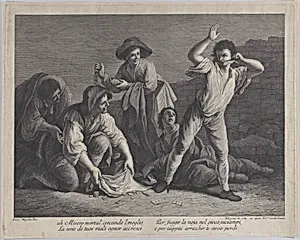
Niccolò Cavalli (1730–1822) was an Italian engraver and print publisher based in Venice, born in Longarone. Little is documented about his early life or formal training, though his long career suggests he honed his skills in the vibrant Venetian graphic arts scene of the mid-18th century. By the 1760s, Cavalli had established himself as a skilled reproductive engraver, collaborating closely with painters to translate their works into popular etchings and aquatints. His output focused on lively genre scenes of everyday Venetian life, capturing the city's carnival spirit, street trades, and rustic amusements with meticulous detail and a touch of Rococo elegance.
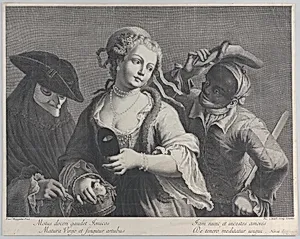
Cavalli frequently partnered with Francesco Maggiotto (1738–1805), a Venetian painter known for his genre works influenced by Pietro Longhi, and the engraver Francesco Pedro (1740–1806). Notable examples include Cavalli's etching *Three half-length figures from a Venetian carnival* after Maggiotto, inscribed "Fran.co Maggiotto Pinx." and "Nic: Cavalli sculp Venetiis," now in the Metropolitan Museum of Art. He also contributed to the series *Arti per via* (1766), where Maggiotto's designs of street artisans—like chair menders and polenta vendors—were engraved by collaborators including Giovanni Volpato. Other prints, such as *Polenta e formaggio* after Maggiotto and Bassano, bear Cavalli's edition mark, showcasing crowded taverns and alchemical workshops alive with motion and social satire.
Working in the late Venetian vedutisti and genre tradition, Cavalli's prints bridged painting and popular dissemination, often with Latin mottos adding moral or humorous commentary. His style emphasized crisp lines, dramatic lighting, and bustling compositions, making art accessible beyond elite collectors. Spanning over five decades, Cavalli's engravings preserved the fading Rococo vitality of 18th-century Venice amid Napoleonic upheavals. Though not as celebrated as his painterly counterparts, his technical prowess and role in print series like those with Maggiotto cemented his legacy in Venetian graphic history, influencing 19th-century reproductive arts. Today, his works appear in major collections, underscoring the collaborative spirit of Venice's artistic workshops.
(Word count: 348)
All 2 artworks loaded