
Ctrl K
1770–1848
**Francesco Puttinati** (1775–1848) was an Italian sculptor, engraver, and medallist, born in Verona and active primarily in Milan, where he died. Little is known about his early life or formal training, as biographical details remain sparsely documented beyond his professional output. He emerged as a master craftsman in the neoclassical tradition, renowned for his intricate bronze and lead relief plaques and medals that faithfully reproduced masterpieces by Renaissance giants. Working in Milan, possibly as an engraver at the local mint, Puttinati bridged classical antiquity and modern neoclassicism through his precise, high-relief interpretations, capturing the grandeur of compositions like Leonardo da Vinci's *The Last Supper* and Raphael's *School of Athens*.
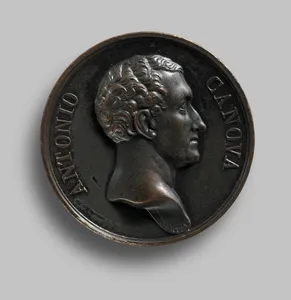
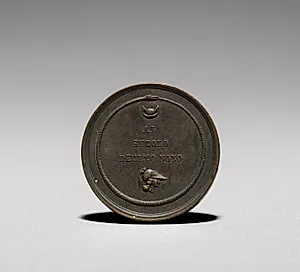
Puttinati's oeuvre includes celebrated plaquettes such as *The Last Supper after Leonardo da Vinci* (two versions at Harvard Art Museums), *Jesus and the Adulteress* after Titian or Raphael, and a bronzed lead relief of Raphael's *School of Athens*. His medals honor luminaries of the era, notably the portrait of neoclassical sculptor Antonio Canova (ca. 1822, Metropolitan Museum of Art and National Gallery of Art), featuring Canova's profile on the obverse and symbolic motifs like an ouroboros encircling Mercury's helmet and Athena's head on the reverse. These works, often rectangular or circular and signed with dates like 1827, showcase his technical virtuosity in patinated metals, evoking the sculptural depth of ancient cameos while serving Grand Tour souvenirs for collectors.
As a pivotal figure in Lombard medallic art, Puttinati influenced the next generation; he was the father of sculptor Alessandro Puttinati (1801–1872), who studied under Bertel Thorvaldsen in Rome, and teacher to engraver Francesco Broggi. His legacy endures in museum collections worldwide, from the Met to Harvard, where his reproductions preserve the spirit of High Renaissance painting in enduring bas-relief. Though not a household name, Puttinati's meticulous craft exemplifies the neoclassical revival's emphasis on harmonious form and historical fidelity, bridging epochs for art enthusiasts today.
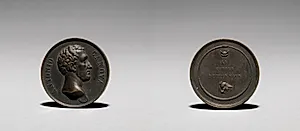
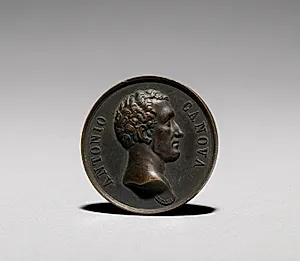
![Antonio Canova, 1757-1822, Sculptor [obverse]](https://images.artheonmuseum.org/nga/thumb/antonio-canova-1757-1822-sculptor-obverse-nga-160863.webp)
![Ouroboros Encircling the Winged Helmet of Mercury and the Head of Athena [reverse]](https://images.artheonmuseum.org/nga/thumb/ouroboros-encircling-the-winged-helmet-of-mercury-nga-162058.webp)