1699–1783
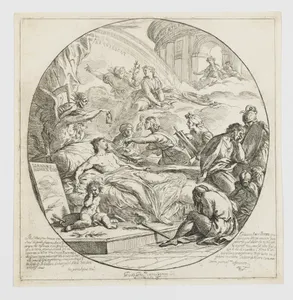
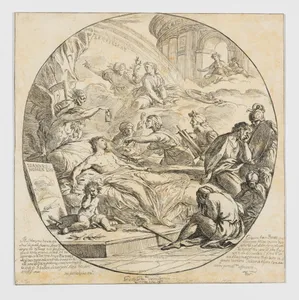
Francisco Vieira de Matos, known as Vieira Lusitano (1699–1783), was one of Portugal's foremost Baroque painters, illustrators, and engravers, renowned for his work as historical painter to the Portuguese royal court. Born in Lisbon on October 4, 1699, he was the third son of Francisco Vieira de Matos, a hosiery manufacturer, and Antónia Maria. Though his family initially groomed him for the clergy, Vieira's childhood talent for drawing redirected his path. Introduced to a literary academy at the Quinta da Boavista in Carnide, he captivated patrons and met Inês Helena de Lima e Melo, igniting a lifelong, tumultuous romance that shadowed his career.
Vieira began his formal training under André Gonçalves in Lisbon before his prodigious skill drew the patronage of the Marquis of Fontes, Portugal's ambassador to Rome. In 1721, the Marquis sponsored his studies abroad, where Vieira trained under the acclaimed Italian masters Benedetto Luti and Francesco Trevisani. He thrived in Rome's vibrant art scene, earning membership in the prestigious Academia de São Lucas. These influences steeped him in the grand Roman Baroque tradition, characterized by dramatic compositions, luminous chiaroscuro, and mythological or religious subjects. Returning to Portugal around 1734, Vieira was appointed historical painter to King John V, producing altarpieces, royal portraits, and illustrations for contemporary publications.
Elevated to knight-professor in the Order of Santiago of the Sword, Vieira Lusitano illustrated numerous works and etched plates that disseminated Portuguese culture. His oeuvre, though not exhaustively cataloged in surviving records, exemplifies the transition from Italianate grandeur to a distinctly Lusophone Rococo inflection. Late in life, amid personal strife—including his unrequited love—Vieira retreated to the Convento do Beato António in Lisbon, where he died on August 13, 1783. His autobiography, published posthumously, offers invaluable insights into 18th-century artistic life, the 1755 Lisbon earthquake's devastation, and court intrigues. Vieira's legacy endures as a bridge between Roman academism and Portuguese Enlightenment art, preserving the era's splendor for posterity.
(Word count: 348)