Ctrl K
**François-Joseph-Aimé de Lemud (1816–1887)** was a versatile French painter, printmaker, lithographer, engraver, and book illustrator whose career spanned the vibrant artistic scene of nineteenth-century France. Born on September 19, 1816, in Thionville, he began his professional life in the 1830s as a book illustrator and lithographer before expanding into engraving. His output reflects the era’s enthusiasm for reproductive prints and literary illustration, techniques that allowed artists to reach wide audiences through publishers and periodicals.
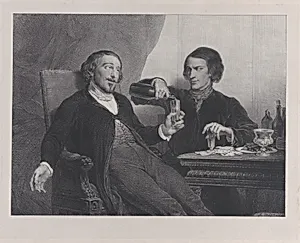
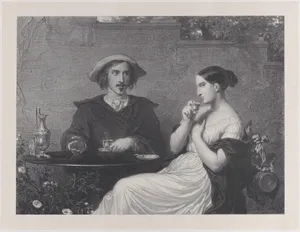
De Lemud gained recognition for his lithographic work published by the prominent Paris firm Rittner & Goupil. Notable examples include the 1840 prints *Le Vin* (Wine) and *Le Café* (Coffee), which capture everyday themes with lively detail and tonal richness typical of the medium. He also created an engraving around 1845 titled *Young Man at a Window* and provided the frontispiece for Victor Hugo’s *Notre-Dame de Paris*, demonstrating his skill in interpreting literary subjects visually. These works highlight his ability to blend narrative content with precise draftsmanship.
Later in his career, de Lemud turned more fully to engraving while continuing to produce drawings and paintings. He settled in Nancy, where he died in 1887. A comprehensive catalogue of his lithographic and engraved oeuvre was compiled by Aglaüs Bouvenne and published in Paris in 1881, underscoring the esteem in which his prints were held by contemporaries.
Today, de Lemud’s prints are preserved in major institutions, including the Metropolitan Museum of Art, the Art Institute of Chicago, and the British Museum, ensuring his contributions to French printmaking and book illustration remain accessible. His association with leading publishers like Rittner & Goupil helped disseminate Romantic-era imagery and literary themes across Europe, cementing his place in the history of nineteenth-century graphic arts.