Ctrl K
**François-Nicolas-Barthélemy Dequevauviller** (1745–1817) was a distinguished French engraver and etcher whose meticulous prints captured the elegance and social scenes of late eighteenth-century Europe. Born in Abbeville, he trained as a pupil of the renowned engraver Jean Daullé, mastering the techniques of etching and engraving that would define his career.
His professional life combined studio work in Paris with extensive travels. Between 1781 and 1786 he journeyed through Italy, Syria, Phoenicia, and Palestine, later exploring Mediterranean coasts; these experiences informed his contributions to illustrated travel albums and topographical series. In Paris he maintained a shop on rue Saint-Hyacinthe before the Revolution and collaborated with fellow engravers Jacques Couché and, around 1791, Pierre-François Laurent.
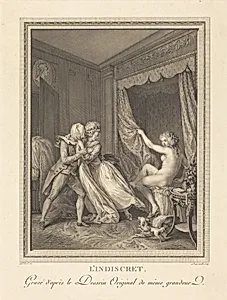
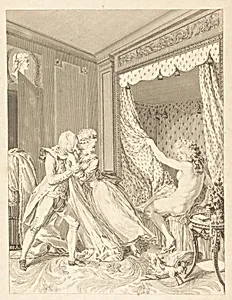
Dequevauviller specialized in reproductive prints after leading painters of his day. Among his most notable works is the 1786 etching and engraving *L’Indiscret* after Antoine Borel, a lively genre scene that exemplifies his skill in rendering light and texture. He also produced celebrated plates after Nicolas Lavreince (also called Lafrensen), including *L’Assemblée au Salon* (1783), *L’Assemblée au concert* (1784), and scenes of fashionable life such as *Le Lever et le Coucher des ouvrières en modes*. His prints were prized for their luminous effects and contributed to major publications such as the *Galerie du Palais Royal* and *Musée Français*.
Dequevauviller’s legacy extended through his family and the enduring appeal of his prints. His son, François-Jacques Dequevauviller (1783–1848), followed in his footsteps as an engraver. Today his works reside in major collections, including the National Gallery of Art and the Metropolitan Museum of Art, where they continue to illuminate the refined visual culture of pre-Revolutionary France.
(Word count: 312)