Ctrl K
1865–1936
Frank Eugene, born Frank Eugene Smith on September 19, 1865, in New York City to German immigrant parents Frederick Smith, a baker, and Hermine Selinger Smith, a singer in local theaters, discovered photography as an amateur pursuit around 1880, possibly while attending City College of New York. In 1886, he traveled to Munich to study drawing and stage design at the Bavarian Academy of Fine Arts, honing skills that would profoundly shape his later photographic practice. Returning to New York around 1894, he initially worked as a theatrical portraitist, sketching actors before transitioning to photography to enhance his painted portraits, exhibiting 77 photographs at the Camera Club in 1899.
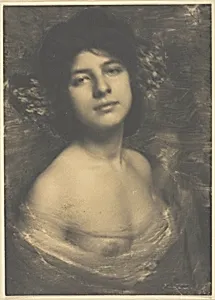
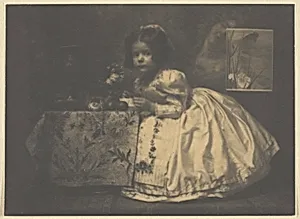
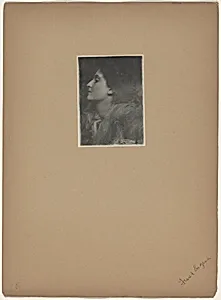
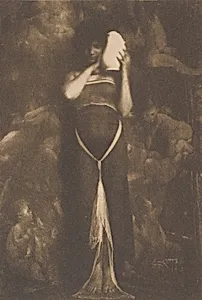
Eugene's meteoric rise in Pictorialist circles peaked in 1900, when an entire issue of *Camera Notes* was devoted to his work and he was elected to London's Brotherhood of the Linked Ring; two years later, he became a founding member of Alfred Stieglitz's Photo-Secession, contributing gravures to *Camera Work* multiple times. In 1906, he relocated permanently to Munich, photographing avant-garde painters like Fritz von Uhde and Willi Geiger, and adopting German citizenship in 1915. There, he embraced experimental techniques, manipulating negatives with scratches, brushes, and pencils to fuse painting and photography in a style critics called "unphotographic photography"—bold, hand-worked images that blurred mediums.
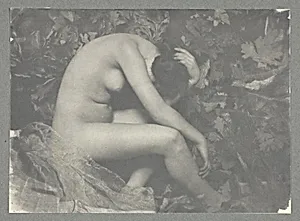
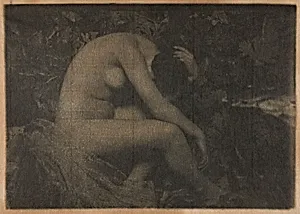
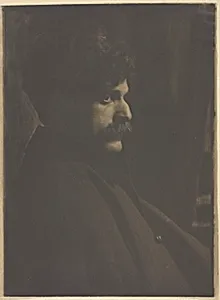
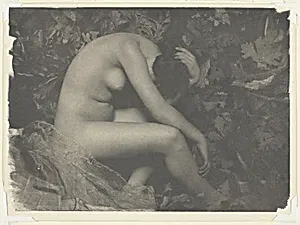
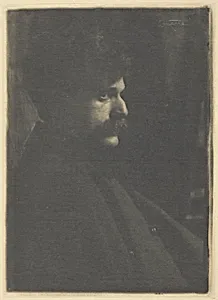
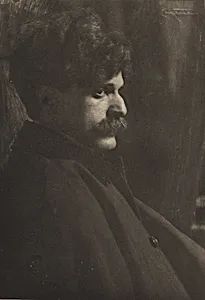
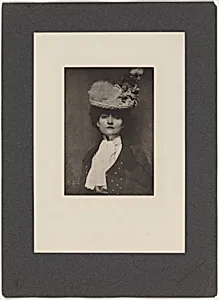
Among his major works, *Adam and Eve* (c. 1898–1900s, published 1910 in *Camera Work*) exemplifies his chiaroscuro nudes with etched surfaces evoking biblical drama, while portraits like *La Cigale* (1898), *Portrait of Alfred Stieglitz* (c. 1899), and *Willi Geiger* (1910) showcase his platinum prints on Japan tissue, pioneering manipulated Pictorialism. From 1907, he lectured at Munich's Lehr- und Versuchsanstalt für Photographie; in 1913, he was appointed the world's first Royal Professor of Pictorial Photography at Leipzig's Royal Academy of Graphic Arts, leading its department until 1927.
Eugene's legacy endures as a bridge between painting and photography, compelling even purists like Stieglitz to admire his innovative syntax. His educational pioneering elevated photography's academic status, cementing Pictorialism's role in legitimizing the medium as fine art.